Amblyomma: Difference between revisions
CSV import |
CSV import |
||
| Line 10: | Line 10: | ||
File:Amblyomma-variegatum-male.jpg|Amblyomma variegatum male | File:Amblyomma-variegatum-male.jpg|Amblyomma variegatum male | ||
</gallery> | </gallery> | ||
==Amblyomma== | |||
'''Amblyomma''' is a genus of hard ticks belonging to the family [[Ixodidae]]. This genus is known for its wide distribution and the role it plays as a vector for various pathogens affecting both humans and animals. Members of this genus are characterized by their ornate scutum and long mouthparts. | |||
==Description== | |||
Ticks of the genus ''Amblyomma'' are relatively large compared to other tick genera. They possess a hard scutum that often displays distinctive patterns or coloration. The mouthparts, or capitulum, are long and adapted for deep penetration into the host's skin, which facilitates feeding on blood. | |||
==Distribution== | |||
''Amblyomma'' species are found worldwide, with a significant presence in tropical and subtropical regions. They are particularly prevalent in the Americas, Africa, and parts of Asia. The distribution of each species within the genus can vary significantly, with some species having a very localized range while others are more widespread. | |||
==Life Cycle== | |||
The life cycle of ''Amblyomma'' ticks includes four stages: egg, larva, nymph, and adult. After hatching from eggs, larvae seek out a host to feed on before molting into nymphs. Nymphs also require a blood meal before they can molt into adults. Adult ticks feed on larger hosts, including mammals, birds, and reptiles. The entire life cycle can take several months to years, depending on environmental conditions and host availability. | |||
==Medical and Veterinary Importance== | |||
''Amblyomma'' ticks are of significant medical and veterinary importance due to their role as vectors of various pathogens. They are known to transmit [[Rickettsia]], [[Ehrlichia]], and [[Coxiella]] species, which can cause diseases such as [[Rocky Mountain spotted fever]], [[ehrlichiosis]], and [[Q fever]]. In livestock, they can transmit pathogens that lead to economic losses due to decreased productivity and increased veterinary costs. | |||
==Species== | |||
There are numerous species within the ''Amblyomma'' genus, some of which include: | |||
* ''[[Amblyomma americanum]]'' - commonly known as the lone star tick, found primarily in the southeastern United States. | |||
* ''[[Amblyomma cajennense]]'' - known as the cayenne tick, found in Central and South America. | |||
* ''[[Amblyomma variegatum]]'' - known as the tropical bont tick, found in Africa and the Caribbean. | |||
==Control and Prevention== | |||
Controlling ''Amblyomma'' tick populations involves integrated pest management strategies, including habitat modification, use of acaricides, and biological control methods. Personal protective measures, such as wearing protective clothing and using tick repellents, are recommended to prevent tick bites in endemic areas. | |||
==Related pages== | |||
* [[Ixodidae]] | |||
* [[Tick-borne disease]] | |||
* [[Vector (epidemiology)]] | |||
{{Tick}} | |||
[[Category:Ticks]] | |||
[[Category:Parasites]] | |||
[[Category:Veterinary entomology]] | |||
Latest revision as of 00:36, 19 February 2025
-
 Amblyomma
 -
 Amblyomma americanum tick
 -
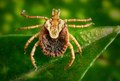 Amblyomma cajennense
 -
 Amblyomma maculatum
 -
 Amblyomma marmoreum
 -
 Amblyomma scalpturatum
 -
 Amblyomma supinoi
 -
 Amblyomma triste
 -
 Amblyomma variegatum male


_-_Mites_-_Collection_Anthonie_Cornelis_Oudemans.jpeg)


Amblyomma[edit]
Amblyomma is a genus of hard ticks belonging to the family Ixodidae. This genus is known for its wide distribution and the role it plays as a vector for various pathogens affecting both humans and animals. Members of this genus are characterized by their ornate scutum and long mouthparts.
Description[edit]
Ticks of the genus Amblyomma are relatively large compared to other tick genera. They possess a hard scutum that often displays distinctive patterns or coloration. The mouthparts, or capitulum, are long and adapted for deep penetration into the host's skin, which facilitates feeding on blood.
Distribution[edit]
Amblyomma species are found worldwide, with a significant presence in tropical and subtropical regions. They are particularly prevalent in the Americas, Africa, and parts of Asia. The distribution of each species within the genus can vary significantly, with some species having a very localized range while others are more widespread.
Life Cycle[edit]
The life cycle of Amblyomma ticks includes four stages: egg, larva, nymph, and adult. After hatching from eggs, larvae seek out a host to feed on before molting into nymphs. Nymphs also require a blood meal before they can molt into adults. Adult ticks feed on larger hosts, including mammals, birds, and reptiles. The entire life cycle can take several months to years, depending on environmental conditions and host availability.
Medical and Veterinary Importance[edit]
Amblyomma ticks are of significant medical and veterinary importance due to their role as vectors of various pathogens. They are known to transmit Rickettsia, Ehrlichia, and Coxiella species, which can cause diseases such as Rocky Mountain spotted fever, ehrlichiosis, and Q fever. In livestock, they can transmit pathogens that lead to economic losses due to decreased productivity and increased veterinary costs.
Species[edit]
There are numerous species within the Amblyomma genus, some of which include:
- Amblyomma americanum - commonly known as the lone star tick, found primarily in the southeastern United States.
- Amblyomma cajennense - known as the cayenne tick, found in Central and South America.
- Amblyomma variegatum - known as the tropical bont tick, found in Africa and the Caribbean.
Control and Prevention[edit]
Controlling Amblyomma tick populations involves integrated pest management strategies, including habitat modification, use of acaricides, and biological control methods. Personal protective measures, such as wearing protective clothing and using tick repellents, are recommended to prevent tick bites in endemic areas.
Related pages[edit]

