Macadamia: Difference between revisions
CSV import |
No edit summary |
||
| (One intermediate revision by the same user not shown) | |||
| Line 1: | Line 1: | ||
{{Short description|An overview of macadamia nuts, their cultivation, nutritional value, and uses.}} | |||
== | ==Macadamia== | ||
Macadamia is a genus of four species of trees indigenous to [[Australia]], and constituting part of the plant family [[Proteaceae]]. They are native to northeastern [[New South Wales]] and central and southeastern [[Queensland]]. The trees are cultivated for their fruit, the macadamia nut, which is a popular food. | |||
== | ==History== | ||
The macadamia tree was first described in 1857 by the German-Australian botanist [[Ferdinand von Mueller]]. The genus was named in honor of the Scottish-Australian chemist [[John Macadam]]. The commercial production of macadamia nuts began in the late 19th century, and they are now grown in several countries, including [[Hawaii]], [[South Africa]], and [[Brazil]]. | |||
== | ==Cultivation== | ||
[[File:Macadamia integrifolia.jpg|thumb|left|Macadamia integrifolia leaves and flowers]] | |||
Macadamia trees thrive in well-drained soils with a pH of 5.0 to 6.5. They require a frost-free climate with moderate rainfall. The trees are typically propagated by grafting to ensure the quality and consistency of the nuts. It takes approximately 7 to 10 years for a macadamia tree to begin producing nuts. | |||
== | ==Nutritional Value== | ||
Macadamia nuts are a | Macadamia nuts are known for their high-fat content, which is predominantly monounsaturated fat. They are also a good source of [[dietary fiber]], [[protein]], [[thiamine]], and [[manganese]]. The nuts are low in carbohydrates and contain no cholesterol, making them a heart-healthy snack option. | ||
== | ==Uses== | ||
Macadamia nuts are consumed raw or roasted and are often used in baking and cooking. They are a popular ingredient in [[cookies]], [[cakes]], and [[confectionery]]. The oil extracted from macadamia nuts is used in cooking and cosmetics due to its stability and moisturizing properties. | |||
==Health Benefits== | |||
Consuming macadamia nuts may offer several health benefits, including improved heart health, weight management, and enhanced metabolic function. The high content of monounsaturated fats can help reduce [[LDL cholesterol]] levels, while the fiber content aids in digestion. | |||
== Gallery == | |||
<gallery> | <gallery> | ||
File:Macadamia_nuts_on_tree.JPG|Macadamia | File:Macadamia_nuts_on_tree.JPG|Macadamia | ||
| Line 39: | Line 35: | ||
File:Macadamia_cracking_tool.jpg|Macadamia | File:Macadamia_cracking_tool.jpg|Macadamia | ||
</gallery> | </gallery> | ||
==Related pages== | |||
* [[Nuts]] | |||
* [[Proteaceae]] | |||
* [[Monounsaturated fat]] | |||
* [[Dietary fiber]] | |||
[[Category:Edible nuts and seeds]] | |||
[[Category:Proteaceae]] | |||
[[Category:Australian cuisine]] | |||
Latest revision as of 17:45, 18 February 2025
An overview of macadamia nuts, their cultivation, nutritional value, and uses.
Macadamia[edit]
Macadamia is a genus of four species of trees indigenous to Australia, and constituting part of the plant family Proteaceae. They are native to northeastern New South Wales and central and southeastern Queensland. The trees are cultivated for their fruit, the macadamia nut, which is a popular food.
History[edit]
The macadamia tree was first described in 1857 by the German-Australian botanist Ferdinand von Mueller. The genus was named in honor of the Scottish-Australian chemist John Macadam. The commercial production of macadamia nuts began in the late 19th century, and they are now grown in several countries, including Hawaii, South Africa, and Brazil.
Cultivation[edit]

Macadamia trees thrive in well-drained soils with a pH of 5.0 to 6.5. They require a frost-free climate with moderate rainfall. The trees are typically propagated by grafting to ensure the quality and consistency of the nuts. It takes approximately 7 to 10 years for a macadamia tree to begin producing nuts.
Nutritional Value[edit]
Macadamia nuts are known for their high-fat content, which is predominantly monounsaturated fat. They are also a good source of dietary fiber, protein, thiamine, and manganese. The nuts are low in carbohydrates and contain no cholesterol, making them a heart-healthy snack option.
Uses[edit]
Macadamia nuts are consumed raw or roasted and are often used in baking and cooking. They are a popular ingredient in cookies, cakes, and confectionery. The oil extracted from macadamia nuts is used in cooking and cosmetics due to its stability and moisturizing properties.
Health Benefits[edit]
Consuming macadamia nuts may offer several health benefits, including improved heart health, weight management, and enhanced metabolic function. The high content of monounsaturated fats can help reduce LDL cholesterol levels, while the fiber content aids in digestion.
Gallery[edit]
-
 Macadamia
 -
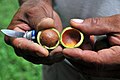 Macadamia
 -
 Macadamia
 -
 Macadamia
 -
 Macadamia
 -
 Macadamia
 -
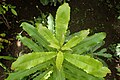 Macadamia
 -
 Macadamia
 -
 Macadamia
 -
 Macadamia
 -
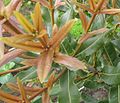 Macadamia
 -
 Macadamia

.jpg)
.jpg)


.jpg)


