Chromosome 5: Difference between revisions
CSV import |
CSV import |
||
| Line 24: | Line 24: | ||
[[Category:Genetics]] | [[Category:Genetics]] | ||
{{medicine-stub}} | {{medicine-stub}} | ||
<gallery> | |||
File:Human_male_karyotpe_high_resolution_-_Chromosome_5_cropped.png|Chromosome 5 cropped | |||
File:Human_male_karyotpe_high_resolution_-_Chromosome_5.png|Chromosome 5 | |||
File:Human_chromosome_5_ideogram_vertical.svg|Chromosome 5 ideogram | |||
File:Human_chromosome_05_-_400_550_850_bphs.png|Chromosome 5 banding patterns | |||
</gallery> | |||
Latest revision as of 05:02, 18 February 2025
Chromosome 5 is one of the 23 pairs of chromosomes in humans. People normally have two copies of this chromosome. Chromosome 5 spans about 181 million base pairs (the building material of DNA) and represents almost 6% of the total DNA in cells.
Structure[edit]
Chromosome 5 is made up of around 181 million base pairs, which are the chemical components that make up DNA. This chromosome is responsible for almost 6% of the total DNA in cells. The structure of the chromosome is divided into two arms - a short arm known as "p" and a long arm known as "q". The centromere, which is the point of constriction, separates these two arms.
Genes[edit]
Chromosome 5 contains about 1,200 genes. Some of the genes on chromosome 5 are ADAMTS2, which is involved in the processing of procollagen, MTRR, which is involved in the repair of DNA, and SLC6A3, which is involved in the uptake of neurotransmitters.
Diseases and disorders[edit]
Several diseases and disorders are related to genes on chromosome 5. These include Cri-du-chat, which is caused by a deletion of the end of the short (p) arm of chromosome 5, and Parkinson's disease, which can be caused by mutations in the SLC6A3 gene.
Research[edit]
Research is currently being conducted on chromosome 5 to understand its structure, functions, and role in disease. This research is expected to provide new insights into human biology and disease.
See also[edit]
References[edit]
<references />

-
 Chromosome 5 cropped
 -
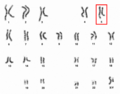 Chromosome 5
 -
 Chromosome 5 ideogram
 -
 Chromosome 5 banding patterns


