Thermodynamics: Difference between revisions
CSV import Tags: mobile edit mobile web edit |
CSV import Tags: mobile edit mobile web edit |
||
| Line 48: | Line 48: | ||
{{Physics-stub}} | {{Physics-stub}} | ||
{{Energy-stub}} | {{Energy-stub}} | ||
<gallery> | |||
File:Eight_founding_schools.png|Eight founding schools of thermodynamics | |||
File:Carnot_engine_(hot_body_-_working_body_-_cold_body).jpg|Carnot engine (hot body - working body - cold body) | |||
File:Kurzzeitfotografie_sektkorken_06-19-s02_2017-09-03_01_hinnerk-ruemenapf_exif.jpg|Thermodynamics | |||
File:system_boundary.svg|System boundary in thermodynamics | |||
</gallery> | |||
Latest revision as of 05:01, 18 February 2025
Thermodynamics is a branch of physics that deals with heat and temperature, and their relation to energy, work, radiation, and properties of matter. The behavior of these quantities is governed by the four laws of thermodynamics which convey a quantitative description using measurable macroscopic physical quantities, but may be explained in terms of microscopic constituents by statistical mechanics.
History[edit]
The history of thermodynamics as a scientific discipline generally begins with Otto von Guericke who, in 1650, built and designed the world's first vacuum pump and demonstrated a vacuum using his Magdeburg hemispheres.
Laws of thermodynamics[edit]
Thermodynamics is principally based on a set of four laws which are universally valid when applied to systems that fall within the constraints implied by each.
Zeroth law[edit]
The zeroth law of thermodynamics states: If two systems are each in thermal equilibrium with a third, they are in thermal equilibrium with each other.
First law[edit]
The first law of thermodynamics, also known as Law of Conservation of Energy, states that energy cannot be created or destroyed in an isolated system.
Second law[edit]
The second law of thermodynamics states that the entropy of any isolated system always increases.
Third law[edit]
The third law of thermodynamics states that the entropy of a system approaches a constant value as the temperature approaches absolute zero.
Applications[edit]
Thermodynamics is applied in many fields of science and engineering, including physical chemistry, chemical engineering, mechanical engineering, cell biology, biomedical engineering, materials science, and aerospace engineering.
See also[edit]
References[edit]
<references />


-
 Eight founding schools of thermodynamics
 -
 Carnot engine (hot body - working body - cold body)
 -
 Thermodynamics
 -
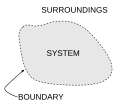 System boundary in thermodynamics

.jpg)


