Weighting: Difference between revisions
CSV import Tags: mobile edit mobile web edit |
CSV import |
||
| Line 42: | Line 42: | ||
{{stub}} | {{stub}} | ||
<gallery> | |||
File:Acoustic_weighting_curves_(1).svg|Acoustic weighting curves | |||
File:Lindos3.svg|Lindos audio test set | |||
File:CCITT_0.41_and_C-Message_weighting_curve.svg|CCITT 0.41 and C-Message weighting curve | |||
File:IEC_98_(1984)_Rumble_Weighting_curves.svg|IEC 98 (1984) Rumble Weighting curves | |||
File:IEC_386_Flutter_weighting.svg|IEC 386 Flutter weighting | |||
</gallery> | |||
Latest revision as of 04:49, 18 February 2025
Weighting is a process used in data analysis and statistics to adjust the impact of different data points on a final result. It is often used when the data being analyzed is not evenly distributed or when certain data points are considered more important than others.
Overview[edit]
In statistics, weighting is used to adjust the contribution of different data points to a final result. This is often done when the data being analyzed is not evenly distributed or when certain data points are considered more important than others. For example, in a survey, responses from people in a certain age group might be given more weight if the survey is trying to understand the opinions of that age group.
Weighting can also be used in other fields, such as economics, psychology, and social sciences. In these fields, weighting can be used to adjust for biases in data collection or to give more importance to certain variables.
Types of Weighting[edit]
There are several types of weighting, including:
- Frequency weighting: This type of weighting is used when the frequency of a data point is important. For example, in a survey, if a certain response is given more frequently, it might be given more weight.
- Reliability weighting: This type of weighting is used when the reliability of a data point is important. For example, in a study, if a certain measurement is known to be more reliable, it might be given more weight.
- Importance weighting: This type of weighting is used when the importance of a data point is important. For example, in a decision-making process, if a certain factor is considered more important, it might be given more weight.
Applications[edit]
Weighting is used in a variety of fields and applications, including:
- Survey research: In survey research, weighting is often used to adjust for biases in the sample. For example, if a survey is conducted online, it might over-represent people who have internet access. To correct for this, responses from people without internet access might be given more weight.
- Economic modeling: In economic modeling, weighting is often used to give more importance to certain variables. For example, in a model of the economy, the impact of government spending might be given more weight than the impact of individual consumer spending.
- Psychological research: In psychological research, weighting is often used to adjust for the reliability of different measurements. For example, if a certain psychological test is known to be more reliable, it might be given more weight in a study.
See also[edit]
 |
 |
-
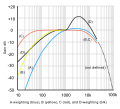 Acoustic weighting curves
 -
 Lindos audio test set
 -
 CCITT 0.41 and C-Message weighting curve
 -
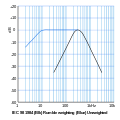 IEC 98 (1984) Rumble Weighting curves
 -
 IEC 386 Flutter weighting
.svg)


_Rumble_Weighting_curves.svg)


