Plantago lanceolata: Difference between revisions
CSV import |
CSV import |
||
| Line 26: | Line 26: | ||
[[Category:Plantaginaceae]] | [[Category:Plantaginaceae]] | ||
{{Flora-stub}} | {{Flora-stub}} | ||
<gallery> | |||
File:Ribwort_600.jpg|Plantago lanceolata | |||
File:Plantago_lanceolata_-_Kulna.jpg|Plantago lanceolata | |||
File:Galled_head_of_a_Plantain.JPG|Galled head of a Plantain | |||
</gallery> | |||
Latest revision as of 04:46, 18 February 2025
Plantago lanceolata, commonly known as Ribwort Plantain, English Plantain, Buckhorn Plantain, and Lamb's Tongue, is a species of flowering plant in the Plantaginaceae family. It is native to Europe and parts of Asia and has been widely naturalized in other parts of the world.
Description[edit]
Plantago lanceolata is a rosette-forming perennial plant that grows to a height of approximately 60 cm. The leaves are lanceolate, ribbed, and hairy, with the lower ones forming a rosette at the base. The flowers are small, white, and borne on a spike that rises above the leaves. The fruit is a small capsule containing two seeds.
Distribution and Habitat[edit]
Plantago lanceolata is native to most of Europe and parts of Asia. It has been introduced to North America, Australia, New Zealand, and other areas. It is commonly found in grasslands, meadows, fields, and disturbed areas.
Uses[edit]
Plantago lanceolata has a long history of use in herbal medicine. The leaves have been used to treat wounds, insect bites, and skin infections. The seeds are a source of psyllium, which is used as a dietary fiber supplement.
Cultivation[edit]
Plantago lanceolata is a hardy plant that can grow in a variety of soil types, including poor, compacted soils. It prefers full sun but can tolerate partial shade. It is drought-tolerant and can survive in dry conditions.
See Also[edit]
References[edit]
<references />

This flora-related article is a stub. You can help WikiMD by expanding it.
-
 Plantago lanceolata
 -
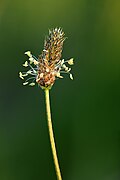 Plantago lanceolata
 -
 Galled head of a Plantain


