Pacific cod: Difference between revisions
CSV import |
CSV import Tags: mobile edit mobile web edit |
||
| Line 30: | Line 30: | ||
{{stub}} | {{stub}} | ||
<gallery> | |||
File:Gadus_macrocephalus.png|Pacific cod illustration | |||
File:Pacific_cod,_capture_production,_thousand_tonnes,_1950-2022.svg|Pacific cod capture production, thousand tonnes, 1950-2022 | |||
File:Pacific_cod_larvae.jpg|Pacific cod larvae | |||
File:Young_Pacific_cod.jpg|Young Pacific cod | |||
</gallery> | |||
Latest revision as of 04:38, 18 February 2025
Pacific cod (Gadus macrocephalus) is a species of ray-finned fish in the family Gadidae. It is a major commercial fish species and is also known as gray cod or grey cod, and grayfish or greyfish. It has three separate dorsal fins, and the catfish-like whiskers on its lower jaw. In appearance, it is similar to the Atlantic cod.
Distribution and habitat[edit]
Pacific cod are found in the colder waters and deeper sea regions throughout the North Pacific ocean, mainly in the Bering Sea. They are found in huge schools that can often occupy several cubic kilometers of ocean. The Pacific cod is an important part of the economy in both Alaska and Russia.
Description[edit]
Pacific cod are around 18 inches to 6 feet long, and their weight can vary from 5 to 50 pounds. They are bottom dwellers and are found at various depths, from the shoreline down to the continental shelf.
Diet[edit]
Pacific cod feed on other fish, crabs, worms, squid, and octopus. Young Pacific cod feed on copepods, amphipods, and other small invertebrates.
Reproduction[edit]
Pacific cod spawn between January and May, with peak spawning occurring in February and March. Females release their eggs in batches, and males guard the eggs for up to a month until they hatch.
Commercial use[edit]
Pacific cod is a major species for commercial fishing industries. They are caught with trawls, longlines and pots. Once caught, the fish are processed into fillets, frozen, and sold in markets around the world.
Conservation status[edit]
The Pacific cod population is currently considered to be healthy. However, there are concerns about the impact of commercial fishing on the species. The IUCN has not yet assessed the Pacific cod's conservation status.
See also[edit]
 |
 |
-
 Pacific cod illustration
 -
 Pacific cod capture production, thousand tonnes, 1950-2022
 -
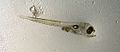 Pacific cod larvae
 -
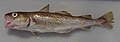 Young Pacific cod


