Cassava cake: Difference between revisions
CSV import Tags: mobile edit mobile web edit |
CSV import |
||
| Line 23: | Line 23: | ||
{{Philippine-cuisine-stub}} | {{Philippine-cuisine-stub}} | ||
{{food-stub}} | {{food-stub}} | ||
<gallery> | |||
File:Cassava_cake_(Philippines)_2.jpg|Cassava cake | |||
File:Cassava_cake_(Philippines)_-_Bibingkang_kamoteng_kahoy_01.jpg|Bibingkang kamoteng kahoy | |||
File:07360jfFilipino_cuisine_foods_desserts_breads_Landmarks_Bulacanfvf_10.jpg|Filipino cuisine desserts | |||
File:Custard_cassava_cake.jpg|Custard cassava cake | |||
File:2714Cuisine_of_Bulacan_Baliuag_03.jpg|Cuisine of Bulacan | |||
</gallery> | |||
Latest revision as of 04:35, 18 February 2025
Cassava Cake is a traditional Filipino dessert made from grated cassava, a root vegetable used in many tropical countries. This cake is known for its moist, sweet and filling characteristics, and is often served during special occasions and festivities in the Philippines.
Ingredients[edit]
The main ingredient of Cassava Cake is the cassava root, also known as yuca or manioc. This root is grated and mixed with coconut milk, condensed milk, and sugar to form the base of the cake. Some recipes also include butter, eggs, and vanilla extract to enhance the flavor. A topping made from coconut cream and condensed milk is often added to the cake before baking.
Preparation[edit]
The preparation of Cassava Cake involves several steps. First, the cassava root is peeled and grated. The grated cassava is then mixed with coconut milk, condensed milk, and sugar to form a batter. This batter is poured into a baking dish and baked until it is firm and golden brown. A topping made from coconut cream and condensed milk is often added to the cake before it is baked for a second time. Once the cake is fully baked, it is allowed to cool before being served.
Variations[edit]
There are several variations of Cassava Cake, each with its own unique twist. Some versions include additional ingredients such as cheese, macapuno (a type of coconut), and jackfruit. There are also variations in the preparation method, with some recipes calling for the cake to be steamed rather than baked.
Cultural Significance[edit]
Cassava Cake is a popular dessert in the Philippines, and is often served during special occasions such as birthdays and weddings. It is also a common offering during religious festivals and celebrations.
See Also[edit]


-
 Cassava cake
 -
 Bibingkang kamoteng kahoy
 -
 Filipino cuisine desserts
 -
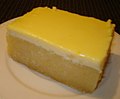 Custard cassava cake
 -
 Cuisine of Bulacan
_2.jpg)
_-_Bibingkang_kamoteng_kahoy_01.jpg)


