Oenothera fruticosa: Difference between revisions
CSV import |
CSV import |
||
| Line 20: | Line 20: | ||
[[Category:Medicinal plants]] | [[Category:Medicinal plants]] | ||
{{Flora-stub}} | {{Flora-stub}} | ||
<gallery> | |||
File:Oenothera_fruticosa_Cumberland_Plateau.jpg|Oenothera fruticosa on the Cumberland Plateau | |||
File:Naturalis_Biodiversity_Center_-_L.2096362_-_Meerburg,_N._-_Oenothera_fruticosa_Linnaeus_-_Artwork.jpeg|Artwork of Oenothera fruticosa by N. Meerburg | |||
File:Oenothera_fruticosa_pollen01.jpg|Pollen of Oenothera fruticosa | |||
</gallery> | |||
Latest revision as of 04:17, 18 February 2025
Oenothera fruticosa, commonly known as the Sundrops or Narrowleaf Evening Primrose, is a species of flowering plant in the Onagraceae family. It is native to eastern and central North America, from Newfoundland west to Alberta and south to Florida and Texas.
Description[edit]
Oenothera fruticosa is a perennial herb that grows up to 120 cm tall. The leaves are lanceolate to elliptic, 3-9 cm long and 1-2.5 cm wide. The flowers are bright yellow, 2.5-5 cm in diameter, with four petals and a bright yellow center. The fruit is a capsule 2-4 cm long and 1-1.5 cm wide.
Habitat and Distribution[edit]
Oenothera fruticosa is found in a variety of habitats, including open woods, prairies, and along roadsides. It prefers well-drained soils and full sun. The species is tolerant of a range of soil conditions, including dry, rocky soils and heavy clay.
Cultivation and Uses[edit]
Oenothera fruticosa is often grown in gardens for its showy yellow flowers. It is also used in traditional medicine, particularly by Native American tribes. The Iroquois used it as a poultice for bruises and the Cherokee used it to treat hemorrhoids.
Conservation Status[edit]
While Oenothera fruticosa is not currently considered threatened, its habitat is being lost to urban development and agriculture. Conservation efforts are focused on preserving its habitat and promoting its cultivation in gardens.
References[edit]
<references />

This flora-related article is a stub. You can help WikiMD by expanding it.
-
 Oenothera fruticosa on the Cumberland Plateau
 -
 Artwork of Oenothera fruticosa by N. Meerburg
 -
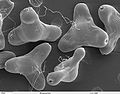 Pollen of Oenothera fruticosa


