Cerebellopontine angle: Difference between revisions
CSV import Tags: mobile edit mobile web edit |
CSV import |
||
| Line 19: | Line 19: | ||
[[Category:Anatomy]] | [[Category:Anatomy]] | ||
{{anatomy-stub}} | {{anatomy-stub}} | ||
<gallery> | |||
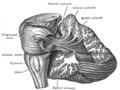
File:Gray705.png|Cerebellopontine angle | |||
File:Human_brain_midsagittal_cut_color.png|Cerebellopontine angle | |||
</gallery> | |||
Latest revision as of 00:58, 18 February 2025
Cerebellopontine angle (CPA) is an anatomical term referring to a region located in the posterior cranial fossa of the human brain. The CPA is a crucial area where several important structures converge, including the cerebellum, the pons, and the internal auditory canal.
Anatomy[edit]
The cerebellopontine angle is defined by the junction of the cerebellum and the pons. It is a wedge-shaped space filled with cerebrospinal fluid, and it is bordered anteriorly by the clivus, posteriorly by the cerebellum, and medially by the pons and the medulla.
The CPA houses several important structures, including the cranial nerves VII (facial nerve) and VIII (vestibulocochlear nerve), as well as the anterior inferior cerebellar artery (AICA) and the labyrinthine artery.
Pathology[edit]
Several types of lesions can occur in the cerebellopontine angle. The most common are acoustic neuromas, also known as vestibular schwannomas, which are benign tumors that arise from the Schwann cells of the vestibulocochlear nerve. Other less common lesions include meningiomas, epidermoid cysts, and arachnoid cysts.
Clinical significance[edit]
Due to the important structures located in the CPA, lesions in this area can lead to a variety of neurological symptoms. These can include hearing loss, tinnitus, vertigo, facial weakness or numbness, and difficulties with balance and coordination.

-
 Cerebellopontine angle
 -
 Cerebellopontine angle


