Nihari: Difference between revisions
CSV import |
CSV import |
||
| Line 22: | Line 22: | ||
[[Category:Bangladeshi cuisine]] | [[Category:Bangladeshi cuisine]] | ||
{{food-stub}} | {{food-stub}} | ||
== Nihari == | |||
<gallery> | |||
File:Mutton_Nihari.jpg|Mutton Nihari | |||
File:Beef_Nihari,_made_by_Saleha_Atif,_Pakistan.jpg|Beef Nihari, made by Saleha Atif, Pakistan | |||
</gallery> | |||
Latest revision as of 00:53, 18 February 2025
Nihari is a traditional South Asian dish that originated from the Mughal era. It is a type of stew that is typically cooked overnight and served for breakfast. The main ingredients of Nihari include meat, usually beef or lamb, and a variety of spices.
History[edit]
Nihari originated in the late 18th century during the Mughal Empire in India. The word 'Nihari' derives from the Arabic word 'Nahar', which means 'day'. It was typically cooked overnight in a large pot and eaten the next morning. Nihari was initially a popular breakfast dish among the labor class. Over time, it gained popularity among the higher classes and became a staple dish in Mughal cuisine.
Preparation[edit]
The preparation of Nihari involves slow cooking meat along with bone marrow for up to 16 hours. The meat is cooked in a stew that includes a variety of spices such as turmeric, cumin, coriander, and ginger. The slow cooking process allows the flavors of the spices to fully infuse into the meat, resulting in a rich and flavorful dish. Nihari is traditionally served with naan bread or rice.
Variations[edit]
There are several regional variations of Nihari. In Pakistan, Nihari is often made with beef or chicken, while in Bangladesh, it is typically made with beef shank. In India, Nihari is often made with lamb or goat meat. Some variations also include the addition of brain or trotters.
Cultural Significance[edit]
Nihari is a popular dish in many South Asian countries, particularly in India, Pakistan, and Bangladesh. It is often served on special occasions and is a common dish during the Islamic month of Ramadan. In recent years, Nihari has gained popularity in other parts of the world, including the United Kingdom and the United States, due to the growing South Asian diaspora.

Nihari[edit]
-
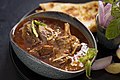 Mutton Nihari
 -
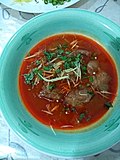 Beef Nihari, made by Saleha Atif, Pakistan


