Tradescantia virginiana: Difference between revisions
CSV import Tags: mobile edit mobile web edit |
CSV import |
||
| Line 34: | Line 34: | ||
[[Category:Flora of the Eastern United States]] | [[Category:Flora of the Eastern United States]] | ||
[[Category:Garden plants of North America]] | [[Category:Garden plants of North America]] | ||
<gallery> | |||
File:Tradescantia_virginiana_Plummers_Island_MD_with_Toxomerus_sp2.jpg|Tradescantia virginiana with Toxomerus sp. | |||
</gallery> | |||
Latest revision as of 02:03, 17 February 2025
Tradescantia virginiana[edit]
Tradescantia virginiana, commonly known as the Virginia spiderwort, is a species of flowering plant in the family Commelinaceae. It is native to the eastern United States and is known for its attractive blue to purple flowers and grass-like foliage.
Description[edit]
Tradescantia virginiana is a herbaceous perennial that typically grows to a height of 30 to 60 cm (12 to 24 inches). The plant has long, narrow leaves that are arranged alternately along the stem. The leaves are smooth and can reach up to 30 cm (12 inches) in length. The flowers are borne in clusters at the ends of the stems and are usually blue or purple, although white-flowered forms exist. Each flower has three petals and six yellow stamens.
Habitat and Distribution[edit]
Tradescantia virginiana is found in a variety of habitats, including woodlands, meadows, and along stream banks. It prefers moist, well-drained soils and can tolerate partial shade to full sun. The species is distributed throughout the eastern United States, from Maine to Alabama and west to Illinois and Kansas.
Cultivation[edit]
Virginia spiderwort is a popular garden plant due to its ease of cultivation and attractive flowers. It is often used in perennial borders, wildflower gardens, and naturalized areas. The plant is hardy in USDA zones 4 through 9. It can be propagated by division or from seed.
Ecological Importance[edit]
Tradescantia virginiana provides nectar and pollen for various pollinators, including bees and butterflies. The plant is also a host for the larvae of some butterfly species. Its ability to thrive in a range of conditions makes it a valuable component of native plant gardens and restoration projects.
Related Species[edit]
Tradescantia virginiana is closely related to other species in the genus Tradescantia, such as Tradescantia ohiensis (Ohio spiderwort) and Tradescantia subaspera (zigzag spiderwort). These species share similar habitats and morphological characteristics.
Related Pages[edit]
Gallery[edit]

-
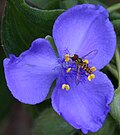 Tradescantia virginiana with Toxomerus sp.
