Lamina propria
Lamina propria is a thin layer of connective tissue that forms part of the moist linings known as mucous membranes or mucosa, which line various tubes in the body, such as the respiratory tract, the gastrointestinal tract, and the urogenital tract.
Structure[edit]
The lamina propria is a component of the mucosa, so it is found in many organs, including the mouth, nose, eyelids, lungs, stomach, and intestines. It is a loose connective tissue, hence it is not as fibrous as the connective tissue of the skin. It contains blood vessels and lymphatic vessels to support the epithelium, as well as fibroblasts, macrophages, and mast cells.
Function[edit]
The lamina propria contains the immune cells of the mucosa, and is the site of immune responses in the mucosa. It provides support and nutrition to the epithelium, as well as the means to bind to the underlying tissue. The fibroblasts produce the collagen of the lamina propria.
Clinical significance[edit]
Changes in the lamina propria can indicate various diseases. For example, an increase in the number of immune cells can indicate an infection or inflammation. In celiac disease, there is a characteristic hyperplasia of the lamina propria.
See also[edit]
 | This medical article is a stub. You can help WikiMD by expanding the page. |
-
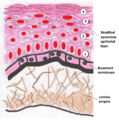 Oral mucosa

Medical Disclaimer: WikiMD is for informational purposes only and is not a substitute for professional medical advice. Content may be inaccurate or outdated and should not be used for diagnosis or treatment. Always consult your healthcare provider for medical decisions. Verify information with trusted sources such as CDC.gov and NIH.gov. By using this site, you agree that WikiMD is not liable for any outcomes related to its content. See full disclaimer.
Credits:Most images are courtesy of Wikimedia commons, and templates, categories Wikipedia, licensed under CC BY SA or similar.
Translate this page: - East Asian
中文,
日本,
한국어,
South Asian
हिन्दी,
தமிழ்,
తెలుగు,
Urdu,
ಕನ್ನಡ,
Southeast Asian
Indonesian,
Vietnamese,
Thai,
မြန်မာဘာသာ,
বাংলা
European
español,
Deutsch,
français,
Greek,
português do Brasil,
polski,
română,
русский,
Nederlands,
norsk,
svenska,
suomi,
Italian
Middle Eastern & African
عربى,
Turkish,
Persian,
Hebrew,
Afrikaans,
isiZulu,
Kiswahili,
Other
Bulgarian,
Hungarian,
Czech,
Swedish,
മലയാളം,
मराठी,
ਪੰਜਾਬੀ,
ગુજરાતી,
Portuguese,
Ukrainian

