Umbilical cord
A structure connecting a developing fetus to the placenta
The umbilical cord is a vital structure in fetal development, serving as the lifeline between the developing fetus and the placenta. It facilitates the exchange of nutrients, gases, and waste products between the mother and the fetus.
Structure[edit]
The umbilical cord typically measures about 50 to 60 centimeters in length and 2 centimeters in diameter at full term. It is composed of three blood vessels: two umbilical arteries and one umbilical vein. The umbilical arteries carry deoxygenated blood and waste products from the fetus to the placenta, while the umbilical vein carries oxygenated blood and nutrients from the placenta to the fetus.
The cord is surrounded by a gelatinous substance known as Wharton's jelly, which provides cushioning and protection to the blood vessels. The outer layer of the cord is covered by a layer of amniotic epithelium.
Function[edit]
The primary function of the umbilical cord is to ensure the transfer of essential substances between the mother and the fetus. Through the umbilical vein, the fetus receives oxygen and nutrients necessary for growth and development. The umbilical arteries, on the other hand, remove carbon dioxide and metabolic waste products from the fetal circulation.
The umbilical cord also plays a role in the regulation of fetal blood flow. The presence of Wharton's jelly helps prevent kinking or compression of the cord, which could otherwise compromise blood flow.
Development[edit]
The umbilical cord begins to form around the fifth week of gestation. It develops from the yolk sac and allantois, structures that are part of the early embryonic development. As the fetus grows, the cord elongates and becomes more coiled.
Clinical Significance[edit]
Umbilical Cord Abnormalities[edit]
Several conditions can affect the umbilical cord, including:
- Nuchal cord: This occurs when the umbilical cord wraps around the fetal neck. It is a common occurrence and often does not cause harm.
- True knot: A true knot in the umbilical cord can potentially restrict blood flow, although many knots do not cause problems.
- Single umbilical artery: This is a condition where one of the umbilical arteries is absent. It can be associated with other congenital anomalies.
Umbilical Cord Blood[edit]
Umbilical cord blood is a rich source of hematopoietic stem cells, which can be used in the treatment of various blood disorders and immune deficiencies. Cord blood banking is an option for parents who wish to preserve these cells for potential future use.
After Birth[edit]
After delivery, the umbilical cord is clamped and cut, leaving a small stump on the newborn's abdomen. This stump typically dries and falls off within the first few weeks of life, leaving the umbilicus, or belly button.
Gallery[edit]
-
 Umbilical cord
 -
 Cross section of the umbilical cord
 -
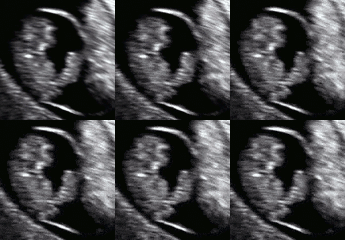 8 weeks 3 days with umbilical cord
 -
 Knotted cord
 -
 Caesarean section operation - cutting the umbilical cord
 -
 Umbilical cord clamp
 -
 Umbilical cord
 -
 Detached umbilical cord
 -
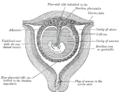 Umbilical cord
 -
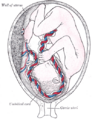 Umbilical cord
 -
 Newborn umbilical suction
 -
 Umbilical cord


Related Pages[edit]

Medical Disclaimer: WikiMD is for informational purposes only and is not a substitute for professional medical advice. Content may be inaccurate or outdated and should not be used for diagnosis or treatment. Always consult your healthcare provider for medical decisions. Verify information with trusted sources such as CDC.gov and NIH.gov. By using this site, you agree that WikiMD is not liable for any outcomes related to its content. See full disclaimer.
Credits:Most images are courtesy of Wikimedia commons, and templates, categories Wikipedia, licensed under CC BY SA or similar.
Translate page: - East Asian
中文,
日本,
한국어,
South Asian
हिन्दी,
தமிழ்,
తెలుగు,
Urdu,
ಕನ್ನಡ,
Southeast Asian
Indonesian,
Vietnamese,
Thai,
မြန်မာဘာသာ,
বাংলা
European
español,
Deutsch,
français,
Greek,
português do Brasil,
polski,
română,
русский,
Nederlands,
norsk,
svenska,
suomi,
Italian
Middle Eastern & African
عربى,
Turkish,
Persian,
Hebrew,
Afrikaans,
isiZulu,
Kiswahili,
Other
Bulgarian,
Hungarian,
Czech,
Swedish,
മലയാളം,
मराठी,
ਪੰਜਾਬੀ,
ગુજરાતી,
Portuguese,
Ukrainian

