Ultraviolet


Ultraviolet (UV) is a form of electromagnetic radiation with a wavelength from 10 nm to 400 nm, shorter than that of visible light but longer than X-rays. UV radiation is present in sunlight, and constitutes about 10% of the total electromagnetic radiation output from the Sun. It is also produced by electric arcs and specialized lights such as mercury-vapor lamps, tanning lamps, and black lights.
Properties[edit]
Ultraviolet radiation is divided into several subtypes, including UVA, UVB, and UVC, based on their wavelength. UVA has the longest wavelengths, followed by UVB, and UVC has the shortest. UVC is mostly absorbed by the Earth's atmosphere and does not reach the surface.
Effects on Health[edit]
Exposure to UV radiation can have both beneficial and harmful effects on human health. It is essential for the production of vitamin D in the skin, but excessive exposure can lead to skin damage, sunburn, and increased risk of skin cancer. UV radiation can also cause damage to the eyes, leading to conditions such as cataracts.
Applications[edit]
Ultraviolet light has various applications in different fields:
- Medical and Sterilization: UV light is used for sterilizing medical equipment and in water purification systems due to its ability to kill bacteria and viruses.
- Forensics: UV light is used in forensic investigations to detect bodily fluids and other substances that fluoresce under UV light.
- Industrial: UV curing is used in the manufacturing of polymers and inks.
- Astronomy: UV astronomy is used to observe astronomical objects in the ultraviolet spectrum.
Environmental Impact[edit]
The ozone layer in the Earth's stratosphere absorbs most of the Sun's harmful UV radiation. Depletion of the ozone layer due to human activities has led to increased UV radiation reaching the Earth's surface, with potential impacts on ecosystems and human health.
Gallery[edit]
-
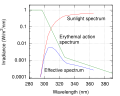 Erythemal action spectrum showing UV effects on skin.
 -
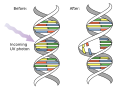 Diagram of DNA mutation caused by UV radiation.
 -
 Sunscreen protecting against UV and visible light.
 -
 Warning sign for UV radiation.
 -
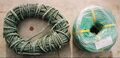 Rope damage due to UV exposure.
 -
 Infrared and UV spectrum comparison.
 -
 Portrait under UV light.
 -
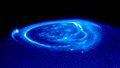 Jupiter's aurora captured in UV light.
 -
 UV security features on a credit card.
 -
 UV screening for hazardous materials.
 -
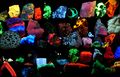 Minerals fluorescing under UV light.
 -
 UV effects on wood finish.
 -
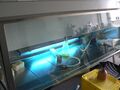 UV disinfection in a laminar flow cabinet.


.jpg)


Related Pages[edit]

Medical Disclaimer: WikiMD is for informational purposes only and is not a substitute for professional medical advice. Content may be inaccurate or outdated and should not be used for diagnosis or treatment. Always consult your healthcare provider for medical decisions. Verify information with trusted sources such as CDC.gov and NIH.gov. By using this site, you agree that WikiMD is not liable for any outcomes related to its content. See full disclaimer.
Credits:Most images are courtesy of Wikimedia commons, and templates, categories Wikipedia, licensed under CC BY SA or similar.
Translate page: - East Asian
中文,
日本,
한국어,
South Asian
हिन्दी,
தமிழ்,
తెలుగు,
Urdu,
ಕನ್ನಡ,
Southeast Asian
Indonesian,
Vietnamese,
Thai,
မြန်မာဘာသာ,
বাংলা
European
español,
Deutsch,
français,
Greek,
português do Brasil,
polski,
română,
русский,
Nederlands,
norsk,
svenska,
suomi,
Italian
Middle Eastern & African
عربى,
Turkish,
Persian,
Hebrew,
Afrikaans,
isiZulu,
Kiswahili,
Other
Bulgarian,
Hungarian,
Czech,
Swedish,
മലയാളം,
मराठी,
ਪੰਜਾਬੀ,
ગુજરાતી,
Portuguese,
Ukrainian

