Pharmacokinetics of progesterone
Pharmacokinetics of Progesterone
Progesterone is a naturally occurring steroid hormone that plays a crucial role in the menstrual cycle, pregnancy, and embryogenesis of humans and other species. The pharmacokinetics of progesterone, which refers to how the body absorbs, distributes, metabolizes, and excretes the hormone, is a complex process that is influenced by various factors.
Absorption[edit]
Progesterone can be administered orally, intramuscularly, or transdermally. The absorption of progesterone varies depending on the route of administration. Oral administration results in rapid absorption, with peak plasma concentrations achieved within 2 to 3 hours. However, oral progesterone undergoes extensive first-pass metabolism, which significantly reduces its bioavailability. Transdermal and intramuscular administration bypasses first-pass metabolism, resulting in higher bioavailability.
Distribution[edit]
Once absorbed, progesterone is distributed throughout the body. It is highly lipophilic and readily crosses cell membranes, including the blood-brain barrier and the placenta. Progesterone is bound to serum proteins, primarily sex hormone-binding globulin (SHBG) and corticosteroid-binding globulin (CBG), with a small fraction remaining unbound or "free."
Metabolism[edit]
Progesterone is primarily metabolized in the liver by the cytochrome P450 enzyme system. The major metabolic pathway involves conversion to pregnanediols and pregnanolones, which are subsequently conjugated with glucuronic acid and excreted in the urine.
Excretion[edit]
The metabolites of progesterone are excreted primarily in the urine. A small amount is also excreted in the bile and ultimately ends up in the feces. The elimination half-life of progesterone is approximately 5 minutes in the blood, but its metabolites have a much longer half-life of several hours.
Factors Influencing Pharmacokinetics[edit]
The pharmacokinetics of progesterone can be influenced by various factors, including age, body weight, liver function, and concomitant medications. Certain medications, such as rifampin and phenytoin, can induce the metabolism of progesterone and reduce its effectiveness.
See Also[edit]

 | This endocrinology article is a stub. You can help WikiMD by expanding the page. |
This gynecology related article is a stub. You can help WikiMD by expanding it.
-
 Progesterone
 -
 Progesterone levels across the normal menstrual cycle in women
 -
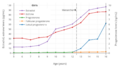 Estrogen and progesterone levels by age during childhood and adolescence in girls
 -
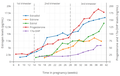 Estrogen and progesterone levels during pregnancy in women
 -
 Progesterone, allopregnanolone, and pregnanolone levels with 200 mg oral progesterone or 400 mg vaginal progesterone
 -
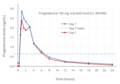 Progesterone levels with 100 mg oral progesterone in postmenopausal women
 -
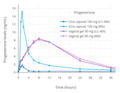 Progesterone levels following a single dose of oral or vaginal micronized progesterone determined with RIA or LC–MS in postmenopausal women
 -
 Progesterone levels with different doses of oral micronized progesterone in postmenopausal women
 -
 Progesterone levels with different preparations of oral progesterone in human volunteers
 -
 Progesterone levels with oral progesterone at different particle sizes in postmenopausal women


Medical Disclaimer: WikiMD is for informational purposes only and is not a substitute for professional medical advice. Content may be inaccurate or outdated and should not be used for diagnosis or treatment. Always consult your healthcare provider for medical decisions. Verify information with trusted sources such as CDC.gov and NIH.gov. By using this site, you agree that WikiMD is not liable for any outcomes related to its content. See full disclaimer.
Credits:Most images are courtesy of Wikimedia commons, and templates, categories Wikipedia, licensed under CC BY SA or similar.
Translate this page: - East Asian
中文,
日本,
한국어,
South Asian
हिन्दी,
தமிழ்,
తెలుగు,
Urdu,
ಕನ್ನಡ,
Southeast Asian
Indonesian,
Vietnamese,
Thai,
မြန်မာဘာသာ,
বাংলা
European
español,
Deutsch,
français,
Greek,
português do Brasil,
polski,
română,
русский,
Nederlands,
norsk,
svenska,
suomi,
Italian
Middle Eastern & African
عربى,
Turkish,
Persian,
Hebrew,
Afrikaans,
isiZulu,
Kiswahili,
Other
Bulgarian,
Hungarian,
Czech,
Swedish,
മലയാളം,
मराठी,
ਪੰਜਾਬੀ,
ગુજરાતી,
Portuguese,
Ukrainian

