Testicular artery
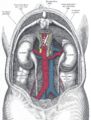
The Testicular artery (also known as the internal spermatic arteries in males and the ovarian arteries in females) is a branch of the abdominal aorta that supplies blood to the testes in males and the ovaries in females. It is a paired artery, with one for each testis or ovary.
Anatomy[edit]
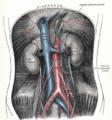
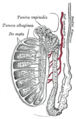
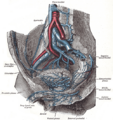
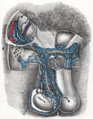
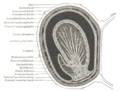
The testicular artery arises from the front of the aorta, just below the renal artery. It descends in the abdomen, and, passing behind the peritoneum, runs along the external iliac artery to the internal inguinal ring, through which it passes, and accompanies the other constituents of the spermatic cord along the inguinal canal to the scrotum.
Function[edit]
The primary function of the testicular artery is to supply blood to the testes. It does this by branching off the aorta, the main blood vessel of the body, and running down to the testes. The blood it carries provides the testes with the oxygen and nutrients they need to function.
Clinical significance[edit]
Damage to the testicular artery can lead to testicular torsion, a medical emergency that can result in the loss of the testis if not treated promptly. Testicular torsion occurs when the spermatic cord, which contains the testicular artery, veins, and nerves, twists and cuts off the blood supply to the testis.
See also[edit]
References[edit]

This WikiMD article can only be edited by registered and verified editors. You can log in or register.
-
 Testicular artery
 -
 Testicular artery
 -
 Testicular artery
 -
 Testicular artery
 -
 Testicular artery
 -
 Testicular artery
 -
 Testicular artery
 -
 Testicular artery
 -
 Testicular artery
 -
 Testicular artery


.jpg)


Medical Disclaimer: WikiMD is for informational purposes only and is not a substitute for professional medical advice. Content may be inaccurate or outdated and should not be used for diagnosis or treatment. Always consult your healthcare provider for medical decisions. Verify information with trusted sources such as CDC.gov and NIH.gov. By using this site, you agree that WikiMD is not liable for any outcomes related to its content. See full disclaimer.
Credits:Most images are courtesy of Wikimedia commons, and templates, categories Wikipedia, licensed under CC BY SA or similar.
Translate page: - East Asian
中文,
日本,
한국어,
South Asian
हिन्दी,
தமிழ்,
తెలుగు,
Urdu,
ಕನ್ನಡ,
Southeast Asian
Indonesian,
Vietnamese,
Thai,
မြန်မာဘာသာ,
বাংলা
European
español,
Deutsch,
français,
Greek,
português do Brasil,
polski,
română,
русский,
Nederlands,
norsk,
svenska,
suomi,
Italian
Middle Eastern & African
عربى,
Turkish,
Persian,
Hebrew,
Afrikaans,
isiZulu,
Kiswahili,
Other
Bulgarian,
Hungarian,
Czech,
Swedish,
മലയാളം,
मराठी,
ਪੰਜਾਬੀ,
ગુજરાતી,
Portuguese,
Ukrainian

