Grey matter
Grey matter is a major component of the central nervous system, consisting of neuron cell bodies, neuropil (dendrites and unmyelinated axons), glial cells (astrocytes and oligodendrocytes), synapses, and capillaries. Grey matter is distinguished from white matter in that it contains numerous cell bodies and relatively few myelinated axons, while white matter contains relatively few cell bodies and is composed chiefly of long-range myelinated axon tracts.
Structure[edit]
The grey matter on the cerebral cortex is a layer of tissue up to 4.5 mm thick covering the cerebrum and cerebellum. There are three types of grey matter in the brain: cortical grey matter, subcortical grey matter, and spinal grey matter. Grey matter includes regions of the brain involved in muscle control, sensory perception such as seeing and hearing, memory, emotions, speech, decision making, and self-control.
Function[edit]
Grey matter serves to process information in the brain. It is responsible for controlling the muscles, processing sensory perceptions, and managing emotions, memory, and decision making. The grey matter in the spinal cord is split into three grey columns: The anterior grey column, the posterior grey column, and the lateral grey column. These columns are tasked with muscle sensory and motor function.
Clinical significance[edit]
Changes in the amount of grey matter in certain regions of the brain are thought to occur in several disorders such as Alzheimer's disease, schizophrenia, bipolar disorder, obsessive-compulsive disorder, and major depressive disorder. Grey matter abnormalities have also been noted in autism and ADHD.
See also[edit]
References[edit]
<references />
 | This medical article is a stub. You can help WikiMD by expanding the page. |
-
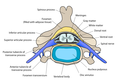 Cervical vertebra
 -
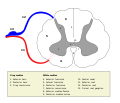 Medulla spinalis section
 -
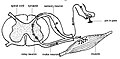 A reflex arc
 -
 Medulla spinalis substantia grisea
 -
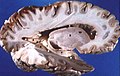 Human brain right dissected lateral view
 -
 Grey matter


Medical Disclaimer: WikiMD is for informational purposes only and is not a substitute for professional medical advice. Content may be inaccurate or outdated and should not be used for diagnosis or treatment. Always consult your healthcare provider for medical decisions. Verify information with trusted sources such as CDC.gov and NIH.gov. By using this site, you agree that WikiMD is not liable for any outcomes related to its content. See full disclaimer.
Credits:Most images are courtesy of Wikimedia commons, and templates, categories Wikipedia, licensed under CC BY SA or similar.
Translate this page: - East Asian
中文,
日本,
한국어,
South Asian
हिन्दी,
தமிழ்,
తెలుగు,
Urdu,
ಕನ್ನಡ,
Southeast Asian
Indonesian,
Vietnamese,
Thai,
မြန်မာဘာသာ,
বাংলা
European
español,
Deutsch,
français,
Greek,
português do Brasil,
polski,
română,
русский,
Nederlands,
norsk,
svenska,
suomi,
Italian
Middle Eastern & African
عربى,
Turkish,
Persian,
Hebrew,
Afrikaans,
isiZulu,
Kiswahili,
Other
Bulgarian,
Hungarian,
Czech,
Swedish,
മലയാളം,
मराठी,
ਪੰਜਾਬੀ,
ગુજરાતી,
Portuguese,
Ukrainian
