Slime mold
Slime mold is a broad term describing some organisms that use spores to reproduce. Slime molds were formerly classified as fungi but are no longer considered part of that kingdom. Although not related to one another, they are still sometimes grouped for convenience. Most slime molds are smaller than a few centimeters, but some species may reach sizes of up to several square meters and masses of up to 30 grams.
Characteristics[edit]
Most slime molds are brightly colored, usually yellow, brown, or white. They are often found in soil, lawns, and on the forest floor, commonly on deciduous logs. However, in tropical areas they are also common on inflorescences and leaves.
Life cycle[edit]
The life cycle of a slime mold mainly consists of four stages: spore, amoeba, plasmodium, and sporangium. The spore stage is the dormant stage. When conditions are right, the spore germinates and releases an amoeba. The amoeba feeds on bacteria and multiplies by cell division. When food is scarce, the amoeba develops into a plasmodium. The plasmodium is a large, single-celled, multinucleate, and shapeless mass. It moves by cytoplasmic streaming and can reach several feet in diameter. When the food supply wanes, the plasmodium develops into a sporangium. The sporangium is a structure that produces and contains spores. When the sporangium matures, it releases spores, which are dispersed by wind or water. The cycle then begins anew.
Classification[edit]
Slime molds, as a group, are polyphyletic. They were originally represented by the subkingdom Gymnomycota in the Fungi kingdom and included the defunct phyla Myxomycota, Acrasiomycota and Labyrinthulomycota. Today, slime molds have been divided among several supergroups, none of which is included in the kingdom Fungi.
See also[edit]
References[edit]

This WikiMD article can only be edited by registered and verified editors. You can log in or register.
-
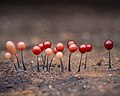 Comatricha nigra
 -
 Lycogala epidendrum - Pink and brown slime molds
 -
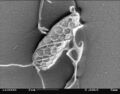 Aplanonet
 -
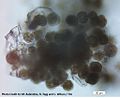 Sporosori
 -
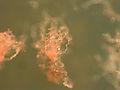 Acrasis rosea
 -
 Badhamia utricularis mature
 -
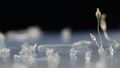 Dictyostelium discoideum
 -
 Ceratiomyxa tunohokori
 -
 Macro photograph of an F. alba colony radius growing on a plate
 -
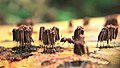 Stemonitis sp. (Slime Mould) with Ant
 -
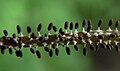 Diachea leucopodia (Bull.) Rostaf
 -
 Fuligo septica


_with_Ant.jpg)
_Rostaf_1014107_(cropped).jpg)

Sponsored Health Resource

W8MD Weight Loss, Sleep & MedSpa
Looking for physician-supervised weight loss, semaglutide, tirzepatide, or GLP-1 receptor agonist options? W8MD helps eligible patients in New York City, Brooklyn, New Jersey, Connecticut, Pennsylvania, Delaware, and greater Philadelphia with medical weight loss, sleep medicine, and long-term maintenance support.
GLP-1 specials: Affordable GLP-1 injections NYC and Philadelphia starting from $29.99/week and up for semaglutide with insurance accepted for qualifying visits, and $45/week and up for tirzepatide with insurance accepted for qualifying visits. Self-pay options start from $59.99/week and up for semaglutide and $69.99/week and up for tirzepatide.
- Medical weight loss NYC
- Affordable GLP-1 injections NYC
- Budget GLP-1 weight loss shots Philadelphia
- New Jersey medical weight loss
- NYC medical weight loss blog
- Philadelphia weight loss blog
- Sleep medicine and sleep apnea services
- W8MD MedSpa and wellness
Book a W8MD appointment · View GLP-1 specials
Paid promotional message. Eligibility, pricing, insurance coverage, medication availability, and results vary. Medical evaluation required.

Medical Disclaimer: WikiMD is for informational purposes only and is not a substitute for professional medical advice. Content may be inaccurate or outdated and should not be used for diagnosis or treatment. Always consult your healthcare provider for medical decisions. Verify information with trusted sources such as CDC.gov and NIH.gov. By using this site, you agree that WikiMD is not liable for any outcomes related to its content. See full disclaimer.
Credits:Most images are courtesy of Wikimedia commons, and templates, categories Wikipedia, licensed under CC BY SA or similar.
Translate page: - East Asian
中文,
日本,
한국어,
South Asian
हिन्दी,
தமிழ்,
తెలుగు,
Urdu,
ಕನ್ನಡ,
Southeast Asian
Indonesian,
Vietnamese,
Thai,
မြန်မာဘာသာ,
বাংলা
European
español,
Deutsch,
français,
Greek,
português do Brasil,
polski,
română,
русский,
Nederlands,
norsk,
svenska,
suomi,
Italian
Middle Eastern & African
عربى,
Turkish,
Persian,
Hebrew,
Afrikaans,
isiZulu,
Kiswahili,
Other
Bulgarian,
Hungarian,
Czech,
Swedish,
മലയാളം,
मराठी,
ਪੰਜਾਬੀ,
ગુજરાતી,
Portuguese,
Ukrainian

