Secondary sex characteristic
Secondary sex characteristics are physical features that distinguish males and females of a species, but that are not directly part of the reproductive system. They are believed to be the product of sexual selection for traits which give an individual an advantage over its rivals in courtship and aggressive interactions. They are distinguished from primary sex characteristics, which are the sex organs.
In humans[edit]
In humans, visible secondary sex characteristics include pubic hair, enlarged breast tissue in females, and facial hair in males. They are one of the many physical changes associated with puberty. The development of secondary sex characteristics is regulated by sex hormones produced by the gonads (testes and ovaries) and the adrenal glands.
In other animals[edit]
In many other animals, secondary sex characteristics play a key role in signaling sexual maturity and fertility. Examples include the bright plumage of male birds, the manes of male lions, and the antlers of male deer.
See also[edit]

This WikiMD article can only be edited by registered and verified editors. You can log in or register.
Secondary sex characteristic[edit]
-
Peacock displaying
-
Adam's apple
-
Red deer stag velvet
-
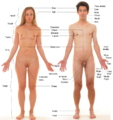 Anterior view of human female and male, with labels


Medical Disclaimer: WikiMD is for informational purposes only and is not a substitute for professional medical advice. Content may be inaccurate or outdated and should not be used for diagnosis or treatment. Always consult your healthcare provider for medical decisions. Verify information with trusted sources such as CDC.gov and NIH.gov. By using this site, you agree that WikiMD is not liable for any outcomes related to its content. See full disclaimer.
Credits:Most images are courtesy of Wikimedia commons, and templates, categories Wikipedia, licensed under CC BY SA or similar.
Translate page: - East Asian
中文,
日本,
한국어,
South Asian
हिन्दी,
தமிழ்,
తెలుగు,
Urdu,
ಕನ್ನಡ,
Southeast Asian
Indonesian,
Vietnamese,
Thai,
မြန်မာဘာသာ,
বাংলা
European
español,
Deutsch,
français,
Greek,
português do Brasil,
polski,
română,
русский,
Nederlands,
norsk,
svenska,
suomi,
Italian
Middle Eastern & African
عربى,
Turkish,
Persian,
Hebrew,
Afrikaans,
isiZulu,
Kiswahili,
Other
Bulgarian,
Hungarian,
Czech,
Swedish,
മലയാളം,
मराठी,
ਪੰਜਾਬੀ,
ગુજરાતી,
Portuguese,
Ukrainian


