Rectouterine pouch
The Rectouterine pouch also known as Douglas's Pouch or Douglas' Space is the deepest point of the female peritoneal cavity. It is located between the rectum and the posterior wall of the uterus in the human female body.
Etymology[edit]
The term "Rectouterine pouch" is derived from its location - between the rectum and the uterus. It is also named after the Scottish anatomist, James Douglas, who made significant contributions to the field of human anatomy in the 18th century.
Anatomy[edit]
The Rectouterine pouch is a part of the female peritoneal cavity. It is located posterior to the uterus and anterior to the rectum. It is the lowest part of the peritoneal cavity, and thus, fluid often accumulates here. The pouch is lined by peritoneum, a thin layer of tissue that also lines the abdominal cavity and most of the organs in the abdomen.
Clinical significance[edit]
The Rectouterine pouch is clinically significant as it is a common site for the accumulation of pathological fluids, such as blood in hemoperitoneum, pus in pyoperitoneum, or ascitic fluid in ascites. It can also be involved in conditions such as endometriosis and pelvic inflammatory disease.
See also[edit]
References[edit]
External links[edit]
- Rectouterine pouch at the U.S. National Library of Medicine Medical Subject Headings (MeSH)

This WikiMD article can only be edited by registered and verified editors. You can log in or register.
Rectouterine_pouch[edit]
-
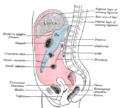 Gray's Anatomy illustration of the female pelvis
 -
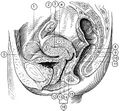 Illustration of the female pelvis


Medical Disclaimer: WikiMD is for informational purposes only and is not a substitute for professional medical advice. Content may be inaccurate or outdated and should not be used for diagnosis or treatment. Always consult your healthcare provider for medical decisions. Verify information with trusted sources such as CDC.gov and NIH.gov. By using this site, you agree that WikiMD is not liable for any outcomes related to its content. See full disclaimer.
Credits:Most images are courtesy of Wikimedia commons, and templates, categories Wikipedia, licensed under CC BY SA or similar.
Translate page: - East Asian
中文,
日本,
한국어,
South Asian
हिन्दी,
தமிழ்,
తెలుగు,
Urdu,
ಕನ್ನಡ,
Southeast Asian
Indonesian,
Vietnamese,
Thai,
မြန်မာဘာသာ,
বাংলা
European
español,
Deutsch,
français,
Greek,
português do Brasil,
polski,
română,
русский,
Nederlands,
norsk,
svenska,
suomi,
Italian
Middle Eastern & African
عربى,
Turkish,
Persian,
Hebrew,
Afrikaans,
isiZulu,
Kiswahili,
Other
Bulgarian,
Hungarian,
Czech,
Swedish,
മലയാളം,
मराठी,
ਪੰਜਾਬੀ,
ગુજરાતી,
Portuguese,
Ukrainian

