Sinoatrial nodal artery
Sinoatrial Nodal Artery is a blood vessel that supplies the Sinoatrial Node with oxygenated blood. The artery is a branch of either the Right Coronary Artery or the Left Circumflex Artery. The origin of the artery can vary among individuals, and this variation can have clinical significance.
Etymology[edit]
The term "Sinoatrial Nodal Artery" is derived from the Latin words "sinus", meaning "bay", "atrium", meaning "central room", and "nodus", meaning "knot". The term refers to the artery's function of supplying the sinoatrial node, which is the natural pacemaker of the heart.
Anatomy[edit]
The Sinoatrial Nodal Artery typically arises from the Right Coronary Artery in about 55% of individuals, and from the Left Circumflex Artery in about 45% of individuals. The artery travels in the atrioventricular groove, and supplies the Sinoatrial Node.
Clinical Significance[edit]
The Sinoatrial Nodal Artery is of clinical importance because it supplies the Sinoatrial Node, which is responsible for initiating the electrical impulses that regulate the heart's rhythm. Blockage of this artery can lead to Sinoatrial Node Dysfunction, also known as Sick Sinus Syndrome.
Related Terms[edit]
- Coronary Arteries
- Sinoatrial Node
- Right Coronary Artery
- Left Circumflex Artery
- Sinoatrial Node Dysfunction
- Sick Sinus Syndrome
 | This medical article is a stub. You can help WikiMD by expanding the page. |
Sinoatrial_nodal_artery[edit]
-
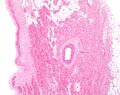 Sinoatrial node under low magnification
 -
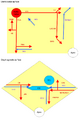 Diagram of cardiac vessels
 -
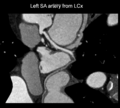 Sinoatrial artery from left circumflex artery
 -
 Volume rendered image of SA artery from LCx
 -
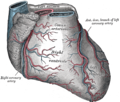 Anatomical illustration of the heart


Medical Disclaimer: WikiMD is for informational purposes only and is not a substitute for professional medical advice. Content may be inaccurate or outdated and should not be used for diagnosis or treatment. Always consult your healthcare provider for medical decisions. Verify information with trusted sources such as CDC.gov and NIH.gov. By using this site, you agree that WikiMD is not liable for any outcomes related to its content. See full disclaimer.
Credits:Most images are courtesy of Wikimedia commons, and templates, categories Wikipedia, licensed under CC BY SA or similar.
Translate this page: - East Asian
中文,
日本,
한국어,
South Asian
हिन्दी,
தமிழ்,
తెలుగు,
Urdu,
ಕನ್ನಡ,
Southeast Asian
Indonesian,
Vietnamese,
Thai,
မြန်မာဘာသာ,
বাংলা
European
español,
Deutsch,
français,
Greek,
português do Brasil,
polski,
română,
русский,
Nederlands,
norsk,
svenska,
suomi,
Italian
Middle Eastern & African
عربى,
Turkish,
Persian,
Hebrew,
Afrikaans,
isiZulu,
Kiswahili,
Other
Bulgarian,
Hungarian,
Czech,
Swedish,
മലയാളം,
मराठी,
ਪੰਜਾਬੀ,
ગુજરાતી,
Portuguese,
Ukrainian

