Quantitative genetics
Quantitative genetics is a branch of genetics that deals with the genetic mechanisms of continuous traits. These are characteristics that can be measured along a gradient, such as height, weight, and blood pressure, as opposed to discrete traits, such as blood type, which fall into clearly defined categories. Quantitative genetics focuses on the inheritance of these traits in populations, and how they are influenced by both genetic and environmental factors.
Overview[edit]
Quantitative traits are often influenced by multiple genes (polygenic inheritance), each contributing a small effect to the overall phenotype. This contrasts with Mendelian traits, which are controlled by a single gene. The study of quantitative genetics involves statistical methods to predict how these traits can be passed from one generation to the next, and how they can be influenced by selection.
Key Concepts[edit]
Phenotypic Variation[edit]
Phenotypic variation refers to the differences in appearance or function observed within a population. In quantitative genetics, this variation is often quantified and analyzed to determine the genetic and environmental contributions to the trait.
Genotypic and Environmental Variance[edit]
The variation in a quantitative trait can be partitioned into genotypic variance, which is due to differences in genes, and environmental variance, which is due to differences in the environment. The total phenotypic variance is the sum of these two components, along with their interaction.
Heritability[edit]
Heritability is a measure of how much of the variation in a trait can be attributed to genetic differences among individuals. It is a key concept in quantitative genetics, as it provides an estimate of the potential response of a trait to selection.
Quantitative Trait Loci (QTL)[edit]
Quantitative Trait Loci (QTL) are specific regions of the genome that are associated with the variation in a quantitative trait. Identifying QTL is a major focus of quantitative genetics research, as it helps in understanding the genetic architecture of complex traits.
Applications[edit]
Quantitative genetics has applications in various fields, including agriculture, where it is used in the breeding of crops and livestock for desirable traits. It also has applications in medicine, particularly in the study of complex diseases that are influenced by multiple genes and environmental factors.
Challenges[edit]
One of the challenges in quantitative genetics is the complex nature of polygenic traits, which can be influenced by a large number of genes with small effects. Additionally, the interaction between genes and the environment can complicate the prediction of phenotypic outcomes.
Future Directions[edit]
Advancements in genomics and bioinformatics are providing new tools for the study of quantitative genetics. These technologies are enabling more precise identification of QTL and a better understanding of the genetic basis of complex traits. This, in turn, is improving the accuracy of genetic predictions and the effectiveness of selection programs in agriculture and medicine.

Quantitative_genetics[edit]
-
Gene effects
-
Sexual reproduction simplified
-
G mean
-
Genetic drift example B3
-
RF Inbreeding
-
RF Inbreeding B
-
Fertilization patterns C
-
RF Inbreeding C c
-
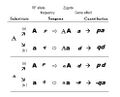 Allele substitution
 -
Model variation 2
-
Fisher variation 1
-
VADf p5


Medical Disclaimer: WikiMD is for informational purposes only and is not a substitute for professional medical advice. Content may be inaccurate or outdated and should not be used for diagnosis or treatment. Always consult your healthcare provider for medical decisions. Verify information with trusted sources such as CDC.gov and NIH.gov. By using this site, you agree that WikiMD is not liable for any outcomes related to its content. See full disclaimer.
Credits:Most images are courtesy of Wikimedia commons, and templates, categories Wikipedia, licensed under CC BY SA or similar.
Translate page: - East Asian
中文,
日本,
한국어,
South Asian
हिन्दी,
தமிழ்,
తెలుగు,
Urdu,
ಕನ್ನಡ,
Southeast Asian
Indonesian,
Vietnamese,
Thai,
မြန်မာဘာသာ,
বাংলা
European
español,
Deutsch,
français,
Greek,
português do Brasil,
polski,
română,
русский,
Nederlands,
norsk,
svenska,
suomi,
Italian
Middle Eastern & African
عربى,
Turkish,
Persian,
Hebrew,
Afrikaans,
isiZulu,
Kiswahili,
Other
Bulgarian,
Hungarian,
Czech,
Swedish,
മലയാളം,
मराठी,
ਪੰਜਾਬੀ,
ગુજરાતી,
Portuguese,
Ukrainian


