Pubic hair
An overview of pubic hair, its functions, and cultural significance
Overview[edit]
Pubic hair is the hair that grows in the genital region of humans, typically beginning during puberty. It is a secondary sexual characteristic that develops in response to hormonal changes in the body. The presence and distribution of pubic hair can vary widely among individuals.
Development[edit]
The development of pubic hair is one of the first signs of puberty. In males, it usually begins between the ages of 9 and 14, while in females, it typically starts between the ages of 8 and 13. The growth of pubic hair is influenced by androgens, which are hormones that increase during puberty.
Stages of Development[edit]
The development of pubic hair is often described using the Tanner scale, which classifies the progression into five stages:
- Stage 1: No pubic hair present.
- Stage 2: Sparse growth of long, slightly pigmented hair at the base of the penis or along the labia.
- Stage 3: Hair becomes darker, coarser, and more curled, spreading sparsely over the pubic region.
- Stage 4: Hair resembles adult pubic hair but covers a smaller area.
- Stage 5: Adult-type hair in quantity and quality, extending to the inner thighs.
Functions[edit]
Pubic hair serves several functions:
- Protection: It provides a protective barrier against friction during sexual intercourse and other activities.
- Pheromone Dispersal: Pubic hair helps in the dispersal of pheromones, which are chemicals that can influence sexual attraction.
- Temperature Regulation: It aids in maintaining the temperature of the genital region.
Cultural Significance[edit]
The presence and grooming of pubic hair have varied cultural significance across different societies and historical periods. In some cultures, the removal of pubic hair is a common practice for aesthetic or hygienic reasons, while in others, it is left natural.
Grooming Practices[edit]
Grooming practices can include trimming, shaving, waxing, or complete removal of pubic hair. These practices are influenced by personal preference, cultural norms, and fashion trends.
Health Considerations[edit]
While pubic hair itself is not harmful, certain grooming practices can lead to health issues such as:
- Irritation and Infection: Shaving or waxing can cause skin irritation, ingrown hairs, and increase the risk of infections.
- Sexually Transmitted Infections (STIs): The removal of pubic hair can sometimes increase the risk of STIs due to micro-abrasions in the skin.
Related Pages[edit]
Pubic_hair[edit]
-
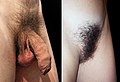 Male and Female Pubic Hair
 -
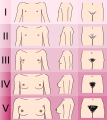 Tanner scale female
 -
 Tanner scale male
 -
 Ceretta a calo inguinale
 -
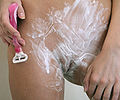 Pubic hair Shaving
 -
 Male genitalia shaving
 -
 Vulva
Vulva -
 Female pubis with hair
 -
 Landing strip pubic hair pattern
 -
 Pubic hair (Brazilian haircut) Triangle style
 -
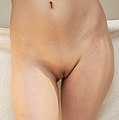 Female abdomen frontal view
 -
 Eve with a Stag


_Triangle_style.jpg)


Medical Disclaimer: WikiMD is for informational purposes only and is not a substitute for professional medical advice. Content may be inaccurate or outdated and should not be used for diagnosis or treatment. Always consult your healthcare provider for medical decisions. Verify information with trusted sources such as CDC.gov and NIH.gov. By using this site, you agree that WikiMD is not liable for any outcomes related to its content. See full disclaimer.
Credits:Most images are courtesy of Wikimedia commons, and templates, categories Wikipedia, licensed under CC BY SA or similar.
Translate page: - East Asian
中文,
日本,
한국어,
South Asian
हिन्दी,
தமிழ்,
తెలుగు,
Urdu,
ಕನ್ನಡ,
Southeast Asian
Indonesian,
Vietnamese,
Thai,
မြန်မာဘာသာ,
বাংলা
European
español,
Deutsch,
français,
Greek,
português do Brasil,
polski,
română,
русский,
Nederlands,
norsk,
svenska,
suomi,
Italian
Middle Eastern & African
عربى,
Turkish,
Persian,
Hebrew,
Afrikaans,
isiZulu,
Kiswahili,
Other
Bulgarian,
Hungarian,
Czech,
Swedish,
മലയാളം,
मराठी,
ਪੰਜਾਬੀ,
ગુજરાતી,
Portuguese,
Ukrainian

