Posterior segment of eyeball
Posterior segment of eyeball refers to the back two-thirds of the eye that includes the anterior vitreous, vitreous body, retina, choroid, and optic nerve. It is a crucial part of the visual system, responsible for receiving and processing light to create visual images.
Anatomy[edit]
The posterior segment is primarily composed of the following structures:
- Anterior vitreous: This is the front part of the vitreous body, a clear gel that fills the space between the lens and the retina.
- Vitreous body: The vitreous body is a clear, jelly-like substance that fills the space between the lens and the retina. It helps to maintain the shape of the eye and transmit light to the retina.
- Retina: The retina is a thin layer of tissue that lines the back of the eye. It contains millions of light-sensitive cells (rods and cones) and other nerve cells that receive and organize visual information.
- Choroid: The choroid is a layer of blood vessels and connective tissue between the sclera and the retina. It provides oxygen and nutrients to the outer layers of the retina.
- Optic nerve: The optic nerve is a bundle of more than one million nerve fibers that transmit visual signals from the retina to the brain.
Function[edit]
The primary function of the posterior segment is to convert light into neural signals and send these signals to the brain for visual recognition. The retina plays a crucial role in this process. When light enters the eye, it is focused onto the retina by the cornea and the lens. The light-sensitive cells in the retina then convert the light into electrical signals. These signals are sent to the brain through the optic nerve, where they are interpreted as the images we see.
Diseases and Disorders[edit]
Several diseases and disorders can affect the posterior segment of the eyeball, including:
- Retinal detachment: This is a serious condition where the retina pulls away from the blood vessels that supply it with oxygen and nutrients.
- Macular degeneration: This is a disease that destroys the sharp, central vision needed for seeing objects clearly and for tasks such as reading and driving.
- Glaucoma: This is a group of eye conditions that damage the optic nerve, often caused by abnormally high pressure in the eye.
- Diabetic retinopathy: This is a diabetes complication that affects the eyes and is caused by damage to the blood vessels of the light-sensitive tissue at the back of the eye (retina).
See Also[edit]

 | This article about the eye is a stub. You can help WikiMD by expanding the page. |
-
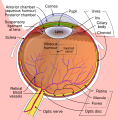 Schematic diagram of the human eye

Sponsored Health Resource

W8MD Weight Loss, Sleep & MedSpa
Looking for physician-supervised weight loss, semaglutide, tirzepatide, or GLP-1 receptor agonist options? W8MD helps eligible patients in New York City, Brooklyn, New Jersey, Connecticut, Pennsylvania, Delaware, and greater Philadelphia with medical weight loss, sleep medicine, and long-term maintenance support.
GLP-1 specials: Affordable GLP-1 injections NYC and Philadelphia starting from $29.99/week and up for semaglutide with insurance accepted for qualifying visits, and $45/week and up for tirzepatide with insurance accepted for qualifying visits. Self-pay options start from $59.99/week and up for semaglutide and $69.99/week and up for tirzepatide.
Medical weight loss NYC | Affordable GLP-1 injections NYC | Budget GLP-1 weight loss shots Philadelphia | New Jersey medical weight loss | NYC medical weight loss | Philadelphia medical weight loss | Sleep clinic NYC | W8MD's Philadelphia GLP-1 doctor | Weight loss prescriptions NYC
Book a W8MD appointment · View GLP-1 specials
Paid promotional message. Eligibility, pricing, insurance coverage, medication availability, and results vary. Medical evaluation required.

Medical Disclaimer: WikiMD is for informational purposes only and is not a substitute for professional medical advice. Content may be inaccurate or outdated and should not be used for diagnosis or treatment. Always consult your healthcare provider for medical decisions. Verify information with trusted sources such as CDC.gov and NIH.gov. By using this site, you agree that WikiMD is not liable for any outcomes related to its content. See full disclaimer.
Credits:Most images are courtesy of Wikimedia commons, and templates, categories Wikipedia, licensed under CC BY SA or similar.
Translate page: - East Asian
中文,
日本,
한국어,
South Asian
हिन्दी,
தமிழ்,
తెలుగు,
Urdu,
ಕನ್ನಡ,
Southeast Asian
Indonesian,
Vietnamese,
Thai,
မြန်မာဘာသာ,
বাংলা
European
español,
Deutsch,
français,
Greek,
português do Brasil,
polski,
română,
русский,
Nederlands,
norsk,
svenska,
suomi,
Italian
Middle Eastern & African
عربى,
Turkish,
Persian,
Hebrew,
Afrikaans,
isiZulu,
Kiswahili,
Other
Bulgarian,
Hungarian,
Czech,
Swedish,
മലയാളം,
मराठी,
ਪੰਜਾਬੀ,
ગુજરાતી,
Portuguese,
Ukrainian

