Plate tectonics
Plate Tectonics is a scientific theory describing the large-scale motion of seven large plates and the movements of a larger number of smaller plates of the Earth's lithosphere, since tectonic processes began on Earth between 3.3 and 3.5 billion years ago. The model builds on the concept of continental drift, an idea developed during the first decades of the 20th century. The geoscientific community accepted plate-tectonic theory after seafloor spreading was validated in the late 1950s and early 1960s.
History[edit]
The concept of plate tectonics has its roots in the continental drift theory, proposed by Alfred Wegener in the early 20th century. However, it was not until the 1960s that the theory was widely accepted, following the discovery of seafloor spreading and the development of paleomagnetism.
Mechanism[edit]
The lithosphere, which is the rigid outermost shell of a planet, is broken up into tectonic plates. On Earth, there are seven or eight major plates (depending on how they are defined) and many minor plates. Where plates meet, their relative motion determines the type of boundary: convergent, divergent, or transform. Earthquakes, volcanic activity, mountain-building, and oceanic trench formation occur along these plate boundaries (or faults).
Plate Boundaries[edit]
Convergent Boundaries[edit]
At convergent boundaries, plates collide with each other. This can lead to the formation of mountain ranges, such as the Himalayas, or deep oceanic trenches, like the Mariana Trench.
Divergent Boundaries[edit]
At divergent boundaries, plates move apart from each other. This can lead to the creation of new crust, such as at the Mid-Atlantic Ridge.
Transform Boundaries[edit]
At transform boundaries, plates slide past each other. This can lead to intense seismic activity, such as the San Andreas Fault in California.
Impact on Earth's Geography[edit]
Plate tectonics has played a key role in shaping the Earth's geography. It has led to the formation of continents, oceans, and various landforms. It also influences patterns of volcanism, earthquakes, and mountain building.
See Also[edit]
 | This geology article is a stub. You can help WikiMD by expanding the page. |
-
 Tectonic plates 2022
 -
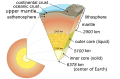 Earth cutaway schematic
 -
 Continental-continental constructive plate boundary
 -
 Continental-continental destructive plate boundary
 -
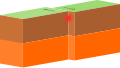 Continental-continental conservative plate boundary opposite directions
 -
 Global plate motion 2008-04-17
 -
 Tectonic plates boundaries physical World map
 -
 Wegener Expedition 1912
 -
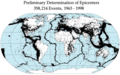 Quake epicenters 1963-98
 -
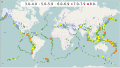 Map of earthquakes in 2016
 -
 Oceanic Stripe Magnetic Anomalies Scheme
 -
 Polarity shift
.svg)


Medical Disclaimer: WikiMD is for informational purposes only and is not a substitute for professional medical advice. Content may be inaccurate or outdated and should not be used for diagnosis or treatment. Always consult your healthcare provider for medical decisions. Verify information with trusted sources such as CDC.gov and NIH.gov. By using this site, you agree that WikiMD is not liable for any outcomes related to its content. See full disclaimer.
Credits:Most images are courtesy of Wikimedia commons, and templates, categories Wikipedia, licensed under CC BY SA or similar.
Translate this page: - East Asian
中文,
日本,
한국어,
South Asian
हिन्दी,
தமிழ்,
తెలుగు,
Urdu,
ಕನ್ನಡ,
Southeast Asian
Indonesian,
Vietnamese,
Thai,
မြန်မာဘာသာ,
বাংলা
European
español,
Deutsch,
français,
Greek,
português do Brasil,
polski,
română,
русский,
Nederlands,
norsk,
svenska,
suomi,
Italian
Middle Eastern & African
عربى,
Turkish,
Persian,
Hebrew,
Afrikaans,
isiZulu,
Kiswahili,
Other
Bulgarian,
Hungarian,
Czech,
Swedish,
മലയാളം,
मराठी,
ਪੰਜਾਬੀ,
ગુજરાતી,
Portuguese,
Ukrainian
