Plantaris muscle
Plantaris muscle is a thin muscle in the posterior compartment of the leg, often absent in humans. It is considered an unimportant muscle and mainly acts with the gastrocnemius.
Etymology[edit]
The term "plantaris" comes from the Latin word "planta", which means "sole". This is because the muscle was believed to play a role in flexing the sole of the foot.
Anatomy[edit]
The plantaris muscle originates from the lower part of the femur, and it inserts into the Achilles tendon. It is innervated by the tibial nerve, a branch of the sciatic nerve. The muscle is approximately 5-10 cm long and is one of the shortest muscles in the human body.
Function[edit]
The plantaris muscle is thought to be involved in proprioception, the body's sense of position and movement. It also assists in flexion of the knee and plantarflexion of the foot.
Clinical significance[edit]
Due to its small size and redundancy, the plantaris muscle is often harvested for use in reconstructive surgery. It is also the muscle most commonly ruptured during sports activities. A rupture of the plantaris muscle can be mistaken for a Achilles tendon rupture due to the similar symptoms.
Related terms[edit]
See also[edit]

This WikiMD article can only be edited by registered and verified editors. You can log in or register.
Plantaris_muscle[edit]
-
 Plantaris muscle animation
 -
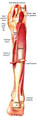 Sobo 1909 304
 -
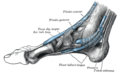 Gray 1242
 -
 Gray 438 Musculus plantaris
 -
 Gray 440 Plantaris
 -
 Plantaris muscle 2
 -
 Space of the gastrocnemius and soleus text


Medical Disclaimer: WikiMD is for informational purposes only and is not a substitute for professional medical advice. Content may be inaccurate or outdated and should not be used for diagnosis or treatment. Always consult your healthcare provider for medical decisions. Verify information with trusted sources such as CDC.gov and NIH.gov. By using this site, you agree that WikiMD is not liable for any outcomes related to its content. See full disclaimer.
Credits:Most images are courtesy of Wikimedia commons, and templates, categories Wikipedia, licensed under CC BY SA or similar.
Translate page: - East Asian
中文,
日本,
한국어,
South Asian
हिन्दी,
தமிழ்,
తెలుగు,
Urdu,
ಕನ್ನಡ,
Southeast Asian
Indonesian,
Vietnamese,
Thai,
မြန်မာဘာသာ,
বাংলা
European
español,
Deutsch,
français,
Greek,
português do Brasil,
polski,
română,
русский,
Nederlands,
norsk,
svenska,
suomi,
Italian
Middle Eastern & African
عربى,
Turkish,
Persian,
Hebrew,
Afrikaans,
isiZulu,
Kiswahili,
Other
Bulgarian,
Hungarian,
Czech,
Swedish,
മലയാളം,
मराठी,
ਪੰਜਾਬੀ,
ગુજરાતી,
Portuguese,
Ukrainian

