Periaqueductal gray
Periaqueductal gray (PAG) is a region located around the cerebral aqueduct within the tegmentum of the midbrain. It plays a crucial role in the modulation of pain and in defensive and reproductive behaviors.
Anatomy[edit]
The periaqueductal gray is so named because it is gray matter situated around the cerebral aqueduct. This region of the brain is involved in numerous functions, including the perception of pain. The PAG is divided into four columns: the dorsomedial, dorsolateral, lateral, and ventrolateral columns. Each column is associated with different functions.
Function[edit]
The PAG plays a key role in the body's response to pain, and is involved in the endogenous analgesia system. It has connections with other areas of the brain that are involved in pain perception, including the thalamus, hypothalamus, and amygdala. The PAG also has a role in defensive and reproductive behaviors.
Clinical significance[edit]
The PAG has been implicated in various conditions related to pain, including chronic pain and migraine. It is also involved in the body's response to stress and anxiety. Understanding the role of the PAG in these conditions could lead to new treatments.
See also[edit]
References[edit]
 | This medical article is a stub. You can help WikiMD by expanding the page. |
-
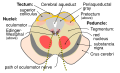 Diagram of the oculomotor nerve nucleus
 -
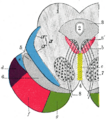 Transverse section of mid-brain at level of superior colliculi
 -
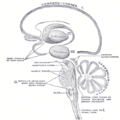 Coronal section of mid-brain
 -
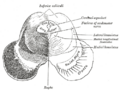 Transverse section of mid-brain at level of inferior colliculi
 -
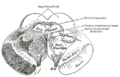 Transverse section of mid-brain at level of inferior colliculi
 -
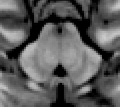 Periaqueductal gray on MRI


Medical Disclaimer: WikiMD is for informational purposes only and is not a substitute for professional medical advice. Content may be inaccurate or outdated and should not be used for diagnosis or treatment. Always consult your healthcare provider for medical decisions. Verify information with trusted sources such as CDC.gov and NIH.gov. By using this site, you agree that WikiMD is not liable for any outcomes related to its content. See full disclaimer.
Credits:Most images are courtesy of Wikimedia commons, and templates, categories Wikipedia, licensed under CC BY SA or similar.
Translate this page: - East Asian
中文,
日本,
한국어,
South Asian
हिन्दी,
தமிழ்,
తెలుగు,
Urdu,
ಕನ್ನಡ,
Southeast Asian
Indonesian,
Vietnamese,
Thai,
မြန်မာဘာသာ,
বাংলা
European
español,
Deutsch,
français,
Greek,
português do Brasil,
polski,
română,
русский,
Nederlands,
norsk,
svenska,
suomi,
Italian
Middle Eastern & African
عربى,
Turkish,
Persian,
Hebrew,
Afrikaans,
isiZulu,
Kiswahili,
Other
Bulgarian,
Hungarian,
Czech,
Swedish,
മലയാളം,
मराठी,
ਪੰਜਾਬੀ,
ગુજરાતી,
Portuguese,
Ukrainian

