Pancreatectomy
Pancreatectomy is a surgical procedure involving the removal of the pancreas. This procedure can be performed for several reasons, most commonly to treat pancreatic cancer or other diseases of the pancreas.
Types of Pancreatectomy[edit]
There are several types of pancreatectomy procedures, including:
- Total pancreatectomy: This involves the removal of the entire pancreas. It is typically performed when cancer has spread throughout the organ.
- Distal pancreatectomy: This procedure involves the removal of the body and tail of the pancreas. It is often performed when a tumor is located in the body or tail of the pancreas.
- Whipple procedure (pancreaticoduodenectomy): This is the most common type of pancreatectomy. It involves the removal of the head of the pancreas, as well as parts of the small intestine, stomach, and gallbladder.
Procedure[edit]
The specific steps of a pancreatectomy can vary depending on the type of procedure being performed. However, in general, the surgery involves the following steps:
- The surgeon makes an incision in the abdomen to access the pancreas.
- The pancreas is carefully separated from the surrounding organs and blood vessels.
- The portion of the pancreas that is diseased or damaged is removed.
- The remaining parts of the pancreas and the surrounding organs are reconnected.
Risks and Complications[edit]
Like all surgeries, a pancreatectomy carries certain risks and potential complications. These can include:
- Infection
- Bleeding
- Blood clots
- Damage to surrounding organs
- Diabetes: Since the pancreas produces insulin, removal of part or all of the pancreas can lead to diabetes.
Recovery[edit]
Recovery from a pancreatectomy can take several weeks. Patients typically need to stay in the hospital for a week or more after the surgery. They may also need to take enzymes to help with digestion and insulin to manage blood sugar levels.
See Also[edit]

This WikiMD article can only be edited by registered and verified editors. You can log in or register.
Pancreatectomy[edit]
-
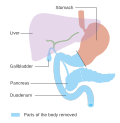 Diagram showing the area removed for surgery to remove all of the pancreas (total pancreatectomy)
 -
 Diagram showing how the bowel is joined back together after a total pancreatectomy
_CRUK_287.svg)

Advertise on WikiMD — 81,000+ full articles, ~900,000 total pages, ~250 million page views. Global reach, limited time promotional rates from $1/page/day. Learn more · View stats


Translate page: - East Asian
中文,
日本,
한국어,
South Asian
हिन्दी,
தமிழ்,
తెలుగు,
Urdu,
ಕನ್ನಡ,
Southeast Asian
Indonesian,
Vietnamese,
Thai,
မြန်မာဘာသာ,
বাংলা
European
español,
Deutsch,
français,
Greek,
português do Brasil,
polski,
română,
русский,
Nederlands,
norsk,
svenska,
suomi,
Italian
Middle Eastern & African
عربى,
Turkish,
Persian,
Hebrew,
Afrikaans,
isiZulu,
Kiswahili,
Other
Bulgarian,
Hungarian,
Czech,
Swedish,
മലയാളം,
मराठी,
ਪੰਜਾਬੀ,
ગુજરાતી,
Portuguese,
Ukrainian
About WikiMD • Contact • Disclaimer • Privacy • Copyright • Site statistics
Some content and images may originate from Wikimedia Commons or Wikipedia and remain subject to their stated licenses. Unless otherwise noted, eligible WikiMD content is available under CC BY-SA 4.0.
WikiMD Wellnesspedia — Free health & wellness information for patients, students, and health professionals.

