Orbital part of frontal bone
[[File: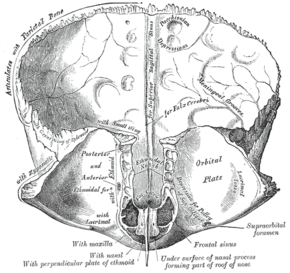 |frameless|alt=]]

| Details | |
|---|---|
| Synonyms | |
| Pronunciation | |
| Carnegie stage | |
| Days | |
| Precursor | |
| Gives rise to | |
| Part of | |
The Orbital part of frontal bone or Pars orbitalis is the smooth, concave part of the frontal bone in the human skull that forms the upper boundary of the orbit.
Structure[edit]
The orbital part of the frontal bone is thin and translucent. It is bounded by the supraorbital margin and the frontal notch or foramen.
Function[edit]
The orbital part of the frontal bone contributes to the formation of the roof of the orbit and contains the frontal sinus.
Clinical significance[edit]
Injuries or diseases affecting the orbital part of the frontal bone can lead to conditions such as orbital fractures or sinusitis.
See also[edit]
References[edit]
```
This code includes an infobox for anatomy, a brief introduction, sections on structure, function, and clinical significance, a see also section, and references. It also includes internal links to related articles and categories at the bottom. The images are from Wikimedia Commons and are properly attributed.
Orbital part of frontal bone[edit]
-
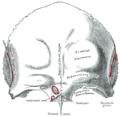 Orbital part of frontal bone
 -
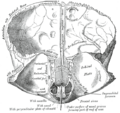 Orbital part of frontal bone
 -
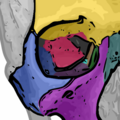 Orbital part of frontal bone
 -
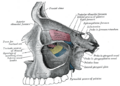 Orbital part of frontal bone
 -
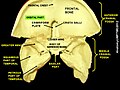 Orbital part of frontal bone
 -
 Orbital part of frontal bone


Medical Disclaimer: WikiMD is for informational purposes only and is not a substitute for professional medical advice. Content may be inaccurate or outdated and should not be used for diagnosis or treatment. Always consult your healthcare provider for medical decisions. Verify information with trusted sources such as CDC.gov and NIH.gov. By using this site, you agree that WikiMD is not liable for any outcomes related to its content. See full disclaimer.
Credits:Most images are courtesy of Wikimedia commons, and templates, categories Wikipedia, licensed under CC BY SA or similar.
Translate this page: - East Asian
中文,
日本,
한국어,
South Asian
हिन्दी,
தமிழ்,
తెలుగు,
Urdu,
ಕನ್ನಡ,
Southeast Asian
Indonesian,
Vietnamese,
Thai,
မြန်မာဘာသာ,
বাংলা
European
español,
Deutsch,
français,
Greek,
português do Brasil,
polski,
română,
русский,
Nederlands,
norsk,
svenska,
suomi,
Italian
Middle Eastern & African
عربى,
Turkish,
Persian,
Hebrew,
Afrikaans,
isiZulu,
Kiswahili,
Other
Bulgarian,
Hungarian,
Czech,
Swedish,
മലയാളം,
मराठी,
ਪੰਜਾਬੀ,
ગુજરાતી,
Portuguese,
Ukrainian

