Proliferating cell nuclear antigen
Proliferating Cell Nuclear Antigen (PCNA) is a protein that plays a crucial role in DNA replication and DNA repair mechanisms within a cell. It acts as a processivity factor for DNA polymerase δ in eukaryotic cells, essentially encircling the DNA strand to increase the enzyme's ability to synthesize DNA efficiently. PCNA is a homotrimer, meaning it is composed of three identical subunits, which form a ring-shaped structure that can slide along the DNA strand.
Structure[edit]
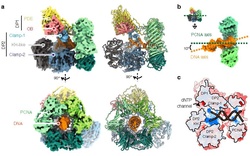
PCNA is a toroidal, or doughnut-shaped, protein complex. Each of its three subunits contributes to the formation of a central hole through which the DNA strand passes. This structure allows PCNA to act as a sliding clamp, maintaining its position on the DNA while allowing the polymerase to move along the strand during replication.
Function[edit]
PCNA is primarily known for its role in DNA replication, where it acts as a processivity factor for DNA polymerase δ. By encircling the DNA, PCNA increases the polymerase's ability to synthesize long stretches of DNA without dissociating. This is crucial for the rapid and accurate replication of the genome during cell division.
In addition to its role in replication, PCNA is also involved in DNA repair processes. It interacts with various proteins involved in nucleotide excision repair, base excision repair, and mismatch repair, helping to coordinate the repair of damaged DNA.
Regulation[edit]
The activity of PCNA is regulated by post-translational modifications, such as ubiquitination and sumoylation. These modifications can alter PCNA's interactions with other proteins and its role in DNA repair pathways. For example, ubiquitination of PCNA is involved in the translesion synthesis pathway, allowing the replication machinery to bypass DNA lesions.
Clinical Significance[edit]
PCNA is often used as a marker for cell proliferation in cancer research and diagnostics. Its expression levels correlate with the rate of cell division, making it a useful indicator of tumor growth and aggressiveness. Additionally, mutations or dysregulation of PCNA and its associated pathways can contribute to genomic instability and cancer development.
Related Pages[edit]

Medical Disclaimer: WikiMD is for informational purposes only and is not a substitute for professional medical advice. Content may be inaccurate or outdated and should not be used for diagnosis or treatment. Always consult your healthcare provider for medical decisions. Verify information with trusted sources such as CDC.gov and NIH.gov. By using this site, you agree that WikiMD is not liable for any outcomes related to its content. See full disclaimer.
Credits:Most images are courtesy of Wikimedia commons, and templates, categories Wikipedia, licensed under CC BY SA or similar.
Translate page: - East Asian
中文,
日本,
한국어,
South Asian
हिन्दी,
தமிழ்,
తెలుగు,
Urdu,
ಕನ್ನಡ,
Southeast Asian
Indonesian,
Vietnamese,
Thai,
မြန်မာဘာသာ,
বাংলা
European
español,
Deutsch,
français,
Greek,
português do Brasil,
polski,
română,
русский,
Nederlands,
norsk,
svenska,
suomi,
Italian
Middle Eastern & African
عربى,
Turkish,
Persian,
Hebrew,
Afrikaans,
isiZulu,
Kiswahili,
Other
Bulgarian,
Hungarian,
Czech,
Swedish,
മലയാളം,
मराठी,
ਪੰਜਾਬੀ,
ગુજરાતી,
Portuguese,
Ukrainian

