Nuremberg trials
The Nuremberg Trials were a series of military tribunals held after World War II to bring Nazi war criminals to justice. These trials were held in the city of Nuremberg, Germany, from 1945 to 1946, and they marked a pivotal moment in the history of international law and human rights. The most notable of these was the Trial of the Major War Criminals before the International Military Tribunal (IMT), which tried 24 of the most important leaders of Nazi Germany.
Background[edit]
After the defeat of Germany, the Allied powers agreed that the leaders of the Nazi regime should be prosecuted for their roles in the Holocaust, the aggressive war, and the atrocities committed during World War II. The London Charter of the International Military Tribunal was drafted, establishing the laws and procedures for the conduct of the trials. The city of Nuremberg was chosen for its symbolic significance, as it had been the site of large Nazi Party rallies.
Trials[edit]
The Nuremberg Trials consisted of 13 trials, but the most famous is the first trial of the major war criminals, which took place from November 20, 1945, to October 1, 1946. The defendants included high-ranking military officers, political leaders, and industrialists. They were charged with crimes against peace, war crimes, crimes against humanity, and conspiracy to commit these crimes.
Principles[edit]
The Nuremberg Trials established several key principles of international law, including the concepts that individuals can be held accountable for their actions under international law, that leaders can be charged for acts committed by their governments, and that following orders is not a sufficient defense for such crimes. These principles were later codified in the Geneva Conventions and the Universal Declaration of Human Rights.
Impact[edit]
The Nuremberg Trials had a profound impact on the development of international criminal law. They led to the establishment of permanent international courts, such as the International Criminal Court, and influenced many national legal systems. The trials also brought to light the extent of Nazi atrocities and contributed to the process of denazification in Germany.
Criticism[edit]
The Nuremberg Trials have been subject to criticism, including allegations of victor's justice, as only the defeated Axis powers were prosecuted. Some have argued that the trials were legally flawed because they applied laws that were not in place at the time the crimes were committed. Despite these criticisms, the Nuremberg Trials are generally regarded as a crucial step towards the establishment of a system of international justice.
Legacy[edit]
The legacy of the Nuremberg Trials continues to influence international law and human rights. The principles established by the trials have been applied in numerous international conflicts and have guided the prosecution of war crimes, genocide, and crimes against humanity. The trials also serve as a reminder of the consequences of totalitarianism and the importance of holding individuals accountable for their actions.

-
Emblem of the International Military Tribunal, Nuremberg
-
Color photograph of judges' bench at IMT
-
Selection on the ramp at Auschwitz-Birkenau, 1944 (Auschwitz Album)
-
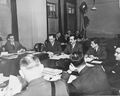 A.N. Trainin speaks at the War Crimes Executive Committee
 -
The Palace of Justice in Nurnberg
-
Ruins of Nuremberg after World War II
-
At a solemn session in Berlin, the representatives of the various nations handed over to the Tribunal their indictments for the Nuremberg Trials
-
Defendants in the dock at Nuremberg trials
-
Evidence in Nuremberg trials


Medical Disclaimer: WikiMD is for informational purposes only and is not a substitute for professional medical advice. Content may be inaccurate or outdated and should not be used for diagnosis or treatment. Always consult your healthcare provider for medical decisions. Verify information with trusted sources such as CDC.gov and NIH.gov. By using this site, you agree that WikiMD is not liable for any outcomes related to its content. See full disclaimer.
Credits:Most images are courtesy of Wikimedia commons, and templates, categories Wikipedia, licensed under CC BY SA or similar.
Translate page: - East Asian
中文,
日本,
한국어,
South Asian
हिन्दी,
தமிழ்,
తెలుగు,
Urdu,
ಕನ್ನಡ,
Southeast Asian
Indonesian,
Vietnamese,
Thai,
မြန်မာဘာသာ,
বাংলা
European
español,
Deutsch,
français,
Greek,
português do Brasil,
polski,
română,
русский,
Nederlands,
norsk,
svenska,
suomi,
Italian
Middle Eastern & African
عربى,
Turkish,
Persian,
Hebrew,
Afrikaans,
isiZulu,
Kiswahili,
Other
Bulgarian,
Hungarian,
Czech,
Swedish,
മലയാളം,
मराठी,
ਪੰਜਾਬੀ,
ગુજરાતી,
Portuguese,
Ukrainian


_1a.jpg)


