Exocytosis
Exocytosis is a process by which a cell transports secretory products through the cytoplasm to the plasma membrane. Secretory products are packaged into transport vesicles (membrane-bound spheres). In the process of exocytosis, these vesicles fuse with the plasma membrane, releasing their contents into the extracellular environment. This process is essential for the maintenance of cellular homeostasis, secretion of hormones and neurotransmitters, and various other cellular functions.
Process of Exocytosis[edit]
Exocytosis begins in the Golgi apparatus, where secretory products are packaged into transport vesicles. These vesicles then move through the cytoplasm towards the plasma membrane. The vesicles are guided by a complex network of cytoskeletal proteins and motor proteins. Upon reaching the plasma membrane, the vesicles fuse with it, releasing their contents into the extracellular environment.
Types of Exocytosis[edit]
There are two main types of exocytosis: constitutive and regulated.
- Constitutive exocytosis is a continuous process that occurs in all cells. It is responsible for the delivery of membrane proteins and lipids to the plasma membrane, and for the secretion of certain proteins into the extracellular environment.
- Regulated exocytosis only occurs in certain cell types and is usually triggered by a specific signal, such as a change in calcium concentration or the binding of a ligand to a receptor on the cell surface. This type of exocytosis is responsible for the secretion of hormones and neurotransmitters.
Role in Cellular Functions[edit]
Exocytosis plays a crucial role in various cellular functions. It is involved in the secretion of hormones and neurotransmitters, the delivery of newly synthesized lipids and proteins to the plasma membrane, the recycling of membrane components, and the expulsion of waste products from the cell.
Diseases Associated with Exocytosis[edit]
Abnormalities in the process of exocytosis can lead to various diseases. For example, defects in the exocytosis of insulin-containing vesicles can lead to diabetes mellitus. Similarly, abnormalities in the exocytosis of neurotransmitters can lead to neurological disorders such as Alzheimer's disease and Parkinson's disease.
See Also[edit]

This WikiMD article can only be edited by registered and verified editors. You can log in or register.
-
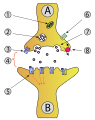 Diagram of a synapse
 -
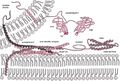 Exocytosis machinery
 -
 Membrane fusion via stalk formation


Medical Disclaimer: WikiMD is for informational purposes only and is not a substitute for professional medical advice. Content may be inaccurate or outdated and should not be used for diagnosis or treatment. Always consult your healthcare provider for medical decisions. Verify information with trusted sources such as CDC.gov and NIH.gov. By using this site, you agree that WikiMD is not liable for any outcomes related to its content. See full disclaimer.
Credits:Most images are courtesy of Wikimedia commons, and templates, categories Wikipedia, licensed under CC BY SA or similar.
Translate page: - East Asian
中文,
日本,
한국어,
South Asian
हिन्दी,
தமிழ்,
తెలుగు,
Urdu,
ಕನ್ನಡ,
Southeast Asian
Indonesian,
Vietnamese,
Thai,
မြန်မာဘာသာ,
বাংলা
European
español,
Deutsch,
français,
Greek,
português do Brasil,
polski,
română,
русский,
Nederlands,
norsk,
svenska,
suomi,
Italian
Middle Eastern & African
عربى,
Turkish,
Persian,
Hebrew,
Afrikaans,
isiZulu,
Kiswahili,
Other
Bulgarian,
Hungarian,
Czech,
Swedish,
മലയാളം,
मराठी,
ਪੰਜਾਬੀ,
ગુજરાતી,
Portuguese,
Ukrainian

