Posterior cutaneous nerve of thigh
Posterior Cutaneous Nerve of Thigh
The Posterior Cutaneous Nerve of Thigh (also known as the posterior femoral cutaneous nerve) is a nerve in the human body that provides sensory innervation to the skin of the posterior aspect of the thigh and the popliteal fossa.
Etymology[edit]
The term "Posterior Cutaneous Nerve of Thigh" is derived from its anatomical position and function. "Posterior" refers to the back or rear, "cutaneous" is derived from Latin cutis meaning skin, and "thigh" refers to the part of the human body between the hip and the knee.
Anatomy[edit]
The Posterior Cutaneous Nerve of Thigh originates from the sacral plexus, specifically from the anterior divisions of the second and third sacral nerves, and from the posterior divisions of the first and second sacral nerves. It descends through the greater sciatic foramen below the piriformis muscle, and accompanies the inferior gluteal artery to the lower part of the gluteus maximus.
Function[edit]
The Posterior Cutaneous Nerve of Thigh provides sensory innervation to the skin of the posterior aspect of the thigh and the popliteal fossa. It also gives off perforating cutaneous branches to the skin of the perineum.
Clinical Significance[edit]
Damage to the Posterior Cutaneous Nerve of Thigh can result in loss of sensation in the areas of the skin it innervates. This can occur due to trauma, surgery, or conditions such as sciatica.
Related Terms[edit]
- Nerve
- Thigh
- Sacral plexus
- Greater sciatic foramen
- Piriformis muscle
- Inferior gluteal artery
- Gluteus maximus muscle
- Sciatica
 | |
|---|---|
 |
 |
-
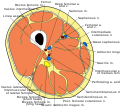 Cross section of the thigh showing muscles and nerves
 -
 Diagram of the posterior cutaneous nerve of the thigh
 -
 Illustration of the sacral plexus and its branches
 -
 Anatomy of the posterior cutaneous nerve of the thigh
 -
 Schematic of the sacral plexus


Ad. Transform your life with W8MD's
GLP-1 weight loss injections special from $29.99 with insurance
|
WikiMD Medical Encyclopedia |
Medical Disclaimer: WikiMD is for informational purposes only and is not a substitute for professional medical advice. Content may be inaccurate or outdated and should not be used for diagnosis or treatment. Always consult your healthcare provider for medical decisions. Verify information with trusted sources such as CDC.gov and NIH.gov. By using this site, you agree that WikiMD is not liable for any outcomes related to its content. See full disclaimer.
Credits:Most images are courtesy of Wikimedia commons, and templates, categories Wikipedia, licensed under CC BY SA or similar.
Translate this page: - East Asian
中文,
日本,
한국어,
South Asian
हिन्दी,
தமிழ்,
తెలుగు,
Urdu,
ಕನ್ನಡ,
Southeast Asian
Indonesian,
Vietnamese,
Thai,
မြန်မာဘာသာ,
বাংলা
European
español,
Deutsch,
français,
Greek,
português do Brasil,
polski,
română,
русский,
Nederlands,
norsk,
svenska,
suomi,
Italian
Middle Eastern & African
عربى,
Turkish,
Persian,
Hebrew,
Afrikaans,
isiZulu,
Kiswahili,
Other
Bulgarian,
Hungarian,
Czech,
Swedish,
മലയാളം,
मराठी,
ਪੰਜਾਬੀ,
ગુજરાતી,
Portuguese,
Ukrainian
