Action potential
An action potential is a rapid rise and subsequent fall in voltage or membrane potential across a cellular membrane with a characteristic pattern. Action potentials occur in several types of animal cells, called excitable cells, which include neurons, muscle cells, and endocrine cells, as well as in some plant cells.
Overview[edit]
An action potential is a fundamental feature of the nervous system and is essential for the propagation of signals along the axon of a neuron. It is a transient event in which the electrical membrane potential of a cell rapidly rises and falls, following a consistent trajectory.
Phases of an Action Potential[edit]
Resting Potential[edit]
The resting potential is the baseline state of the neuron, typically around -70 mV. This is maintained by the sodium-potassium pump and the differential permeability of the membrane to sodium and potassium ions.
Depolarization[edit]
During depolarization, voltage-gated sodium channels open, allowing sodium ions to flow into the cell. This causes the membrane potential to become more positive.
Repolarization[edit]
Repolarization occurs when the sodium channels close and voltage-gated potassium channels open, allowing potassium ions to flow out of the cell, returning the membrane potential to a negative value.
Hyperpolarization[edit]
Hyperpolarization is a phase where the membrane potential becomes more negative than the resting potential. This is due to the continued efflux of potassium ions.
Refractory Period[edit]
The refractory period is a period of time during which a neuron is unable to fire another action potential. It consists of the absolute refractory period and the relative refractory period.
Propagation of Action Potentials[edit]
Action potentials propagate along the axon of a neuron. In myelinated axons, the action potential jumps between nodes of Ranvier in a process called saltatory conduction. This increases the speed of transmission.
Role in Synaptic Transmission[edit]
Action potentials play a crucial role in synaptic transmission. When an action potential reaches the axon terminal, it triggers the release of neurotransmitters into the synaptic cleft, which then bind to receptors on the postsynaptic neuron.
Pacemaker Potentials[edit]
Pacemaker potentials are spontaneous depolarizations that occur in certain types of cells, such as those in the sinoatrial node of the heart. These potentials are responsible for initiating the rhythmic contractions of the heart.
Related pages[edit]
Gallery[edit]
-
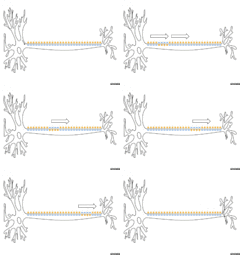 Animation of an action potential.
 -
 Basic shape of an action potential.
 -
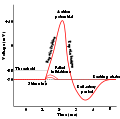 Graph of an action potential.
 -
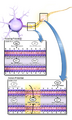 Illustration of action potential in a nerve.
 -
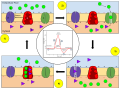 Membrane permeability during an action potential.
 -
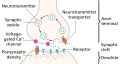 Diagram of a synapse.
 -
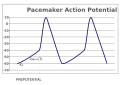 Graph of a pacemaker potential.
 -
 Image of a neuron.
 -
 Conduction velocity and myelination.
 -
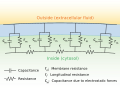 Cable theory in neurons.
 -
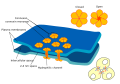 Gap junctions in cells.


Medical Disclaimer: WikiMD is for informational purposes only and is not a substitute for professional medical advice. Content may be inaccurate or outdated and should not be used for diagnosis or treatment. Always consult your healthcare provider for medical decisions. Verify information with trusted sources such as CDC.gov and NIH.gov. By using this site, you agree that WikiMD is not liable for any outcomes related to its content. See full disclaimer.
Credits:Most images are courtesy of Wikimedia commons, and templates, categories Wikipedia, licensed under CC BY SA or similar.
Translate page: - East Asian
中文,
日本,
한국어,
South Asian
हिन्दी,
தமிழ்,
తెలుగు,
Urdu,
ಕನ್ನಡ,
Southeast Asian
Indonesian,
Vietnamese,
Thai,
မြန်မာဘာသာ,
বাংলা
European
español,
Deutsch,
français,
Greek,
português do Brasil,
polski,
română,
русский,
Nederlands,
norsk,
svenska,
suomi,
Italian
Middle Eastern & African
عربى,
Turkish,
Persian,
Hebrew,
Afrikaans,
isiZulu,
Kiswahili,
Other
Bulgarian,
Hungarian,
Czech,
Swedish,
മലയാളം,
मराठी,
ਪੰਜਾਬੀ,
ગુજરાતી,
Portuguese,
Ukrainian

