Pectoralis major
Pectoralis Major
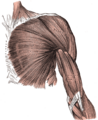
The Pectoralis Major is a thick, fan-shaped muscle, situated at the chest (anterior) of the human body. It makes up the bulk of the chest muscles in the male and lies under the breast in the female.
Anatomy[edit]
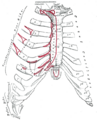
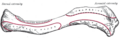
The Pectoralis Major muscle arises from the anterior surface of the sternum, the superior six costal cartilages, and the aponeurosis of the abdominal external oblique muscle. It has two parts: the clavicular part and the sternocostal part.
Function[edit]
The Pectoralis Major has several functions. It adducts and medially rotates the humerus. It also draws the scapula anteriorly and inferiorly. The Pectoralis Major is also responsible for keeping the arm attached to the trunk of the body.
Clinical significance[edit]
Injuries to the Pectoralis Major are rare but can occur in weightlifting, wrestling, and other activities that require extensive use of the upper body. Treatment for these injuries can range from rest and physical therapy to surgery.
See also[edit]
References[edit]
External links[edit]
- Pectoralis Major on PubMed Health
 | This medical article is a stub. You can help WikiMD by expanding the page. |
-
Pectoralis_major
-
 Pectoralis_major
 -
Pectoralis_major
-
Pectoralis_major
-
Pectoralis_major
-
Pectoralis_major
-
Pectoralis_major
-
Pectoralis_major
-
Pectoralis_major
-
 Pectoralis_major
 -
 Pectoralis_major
 -
 Pectoralis_major


Medical Disclaimer: WikiMD is for informational purposes only and is not a substitute for professional medical advice. Content may be inaccurate or outdated and should not be used for diagnosis or treatment. Always consult your healthcare provider for medical decisions. Verify information with trusted sources such as CDC.gov and NIH.gov. By using this site, you agree that WikiMD is not liable for any outcomes related to its content. See full disclaimer.
Credits:Most images are courtesy of Wikimedia commons, and templates, categories Wikipedia, licensed under CC BY SA or similar.
Translate this page: - East Asian
中文,
日本,
한국어,
South Asian
हिन्दी,
தமிழ்,
తెలుగు,
Urdu,
ಕನ್ನಡ,
Southeast Asian
Indonesian,
Vietnamese,
Thai,
မြန်မာဘာသာ,
বাংলা
European
español,
Deutsch,
français,
Greek,
português do Brasil,
polski,
română,
русский,
Nederlands,
norsk,
svenska,
suomi,
Italian
Middle Eastern & African
عربى,
Turkish,
Persian,
Hebrew,
Afrikaans,
isiZulu,
Kiswahili,
Other
Bulgarian,
Hungarian,
Czech,
Swedish,
മലയാളം,
मराठी,
ਪੰਜਾਬੀ,
ગુજરાતી,
Portuguese,
Ukrainian


_1232.jpg)


