Siraitia grosvenorii
Siraitia grosvenorii (also known as Monk fruit or luo han guo) is a herbaceous perennial vine of the Cucurbitaceae (gourd) family, native to southern China and northern Thailand. The plant is well known for its sweet fruits, which are often used as a sugar substitute.
Etymology[edit]
The plant's name, Siraitia grosvenorii, is derived from the Indonesian botanist, Odoardo Beccari, who discovered and named the plant. The species name, grosvenorii, is in honor of Gilbert Hovey Grosvenor, a president of the National Geographic Society, which funded an expedition that brought back live plants.
Description[edit]
Siraitia grosvenorii is a perennial vine that grows up to 5 meters in length. The plant has heart-shaped leaves and yellow or green flowers. The fruit of the plant is round and approximately 3-5 cm in diameter. The fruit's exterior is covered in fine hairs and is initially green, turning brown or partially brown as it matures.
Cultivation and uses[edit]
The plant is primarily grown in the southern Chinese provinces of Guangxi, Guangdong, and Guizhou. The fruit is typically harvested in the form of a dried, round, brown or partially brown fruit. The fruit is known for its sweet taste, which is often used as a sugar substitute in traditional Chinese medicine. The fruit is also used in the production of Monk fruit sweetener, a natural, zero-calorie sweetener that is growing in popularity.
Health benefits[edit]
The fruit of Siraitia grosvenorii has been used in traditional Chinese medicine for centuries to treat a variety of ailments, including coughs, sore throats, and gastrointestinal disorders. Recent studies have also suggested that the fruit may have anti-inflammatory, antioxidant, and anti-cancer properties.
See also[edit]

This WikiMD article can only be edited by registered and verified editors. You can log in or register.
-
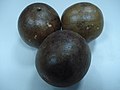 Dried Fructus Momordicae
 -
 Open Luohanguo fruit
 -
 Monkfruit Sweetener


Medical Disclaimer: WikiMD is for informational purposes only and is not a substitute for professional medical advice. Content may be inaccurate or outdated and should not be used for diagnosis or treatment. Always consult your healthcare provider for medical decisions. Verify information with trusted sources such as CDC.gov and NIH.gov. By using this site, you agree that WikiMD is not liable for any outcomes related to its content. See full disclaimer.
Credits:Most images are courtesy of Wikimedia commons, and templates, categories Wikipedia, licensed under CC BY SA or similar.
Translate page: - East Asian
中文,
日本,
한국어,
South Asian
हिन्दी,
தமிழ்,
తెలుగు,
Urdu,
ಕನ್ನಡ,
Southeast Asian
Indonesian,
Vietnamese,
Thai,
မြန်မာဘာသာ,
বাংলা
European
español,
Deutsch,
français,
Greek,
português do Brasil,
polski,
română,
русский,
Nederlands,
norsk,
svenska,
suomi,
Italian
Middle Eastern & African
عربى,
Turkish,
Persian,
Hebrew,
Afrikaans,
isiZulu,
Kiswahili,
Other
Bulgarian,
Hungarian,
Czech,
Swedish,
മലയാളം,
मराठी,
ਪੰਜਾਬੀ,
ગુજરાતી,
Portuguese,
Ukrainian

