Mesentery
Mesentery
The Mesentery is a continuous set of tissues which attaches the intestines to the posterior abdominal wall in humans and is formed by the double fold of peritoneum. It helps in storing fat and allowing blood vessels, lymphatics, and nerves to supply the intestines, among other functions.
Structure[edit]
The mesentery wraps around the intestines and other organs, forming a continuous, folded band of tissue. It is made up of two layers of a fatty membrane called the peritoneum. The mesentery is attached to the entire length of the small intestine and a portion of the large intestine.
Function[edit]
The mesentery has several important functions. It helps to anchor the intestines in place, preventing them from collapsing into the pelvic cavity. The mesentery also contains blood vessels, which supply the intestines with blood. It also contains lymphatic vessels, which help to transport lymph - a fluid that contains infection-fighting white blood cells - throughout the body.
Clinical significance[edit]
The mesentery can be affected by a number of diseases, including inflammation, cancer, and ischemia. Inflammation of the mesentery, known as mesenteritis, can cause severe abdominal pain. Mesenteric ischemia, a condition in which blood flow to the mesentery is reduced, can lead to tissue death and is a medical emergency.
History[edit]
The concept of the mesentery as a distinct organ has evolved over time. It was first described by the ancient Greeks, but its importance was not fully understood until the 19th century. In 2016, the mesentery was officially recognized as a distinct organ in the human body.
See also[edit]
References[edit]
<references />
 | |
|---|---|
 |
 |
Mesentery[edit]
-
 Mesentery extending from the duodenojejunal flexure to the ileocecal junction
 -
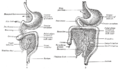 Gray's Anatomy illustration of the mesentery
 -
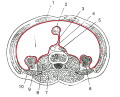 Gray's Anatomy vector illustration of the mesentery
 -
 Gray's Anatomy illustration of the mesentery and intestines
 -
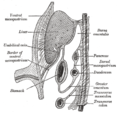 Gray's Anatomy illustration of the mesentery and surrounding structures
 -
 Dissection of the small intestine showing the mesentery
.png)


Ad. Transform your health with W8MD Weight Loss, Sleep & MedSpa

Tired of being overweight?
Special offer:
Budget GLP-1 weight loss medications
- Semaglutide starting from $29.99/week and up with insurance for visit of $59.99 and up per week self pay.
- Tirzepatide starting from $45.00/week and up (dose dependent) or $69.99/week and up self pay
✔ Same-week appointments, evenings & weekends ✔ Tele visits available with certain limitations Learn more:
- GLP-1 weight loss clinic NYC
- W8MD's NYC medical weight loss
- W8MD Philadelphia GLP-1 shots
- Philadelphia GLP-1 injections
- Affordable GLP-1 shots NYC
- Budget GLP-1 shots
|
WikiMD Medical Encyclopedia |
Medical Disclaimer: WikiMD is for informational purposes only and is not a substitute for professional medical advice. Content may be inaccurate or outdated and should not be used for diagnosis or treatment. Always consult your healthcare provider for medical decisions. Verify information with trusted sources such as CDC.gov and NIH.gov. By using this site, you agree that WikiMD is not liable for any outcomes related to its content. See full disclaimer.
Credits:Most images are courtesy of Wikimedia commons, and templates, categories Wikipedia, licensed under CC BY SA or similar.
Translate this page: - East Asian
中文,
日本,
한국어,
South Asian
हिन्दी,
தமிழ்,
తెలుగు,
Urdu,
ಕನ್ನಡ,
Southeast Asian
Indonesian,
Vietnamese,
Thai,
မြန်မာဘာသာ,
বাংলা
European
español,
Deutsch,
français,
Greek,
português do Brasil,
polski,
română,
русский,
Nederlands,
norsk,
svenska,
suomi,
Italian
Middle Eastern & African
عربى,
Turkish,
Persian,
Hebrew,
Afrikaans,
isiZulu,
Kiswahili,
Other
Bulgarian,
Hungarian,
Czech,
Swedish,
മലയാളം,
मराठी,
ਪੰਜਾਬੀ,
ગુજરાતી,
Portuguese,
Ukrainian
