Median aperture
Median aperture (also known as the median aperture of the fourth ventricle, foramen of Magendie, or Magendie's foramen) is an opening in the brain that allows the passage of cerebrospinal fluid (CSF) from the fourth ventricle to the subarachnoid space. It is one of the three openings in the ventricles, the other two being the lateral apertures (also known as the foramina of Luschka).
Etymology[edit]
The median aperture is named after the French physician François Magendie who discovered it. The term "aperture" comes from the Latin "apertura", meaning an opening, while "median" refers to its central location.
Anatomy[edit]
The median aperture is located in the inferior part of the fourth ventricle, in the rhomboid fossa. It is the only median opening, with one located in each of the ventricles. The median aperture allows the cerebrospinal fluid (CSF) to flow from the fourth ventricle into the cisterna magna, and then into the subarachnoid space surrounding the brain and spinal cord.
Function[edit]
The primary function of the median aperture is to allow the passage of CSF from the fourth ventricle to the subarachnoid space. This is crucial for the circulation of CSF, which provides cushioning for the brain, helps to deliver nutrients to the brain and remove waste, and plays a role in maintaining the internal environment of the brain.
Clinical significance[edit]
Blockage or obstruction of the median aperture can lead to a condition known as hydrocephalus, where there is an accumulation of CSF in the brain. This can cause increased intracranial pressure and can lead to symptoms such as headache, nausea, vomiting, and in severe cases, can be life-threatening.
See also[edit]
References[edit]
 | This medical article is a stub. You can help WikiMD by expanding the page. |
Median_aperture[edit]
-
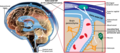 CSF circulation
 -
 Slide 3


Medical Disclaimer: WikiMD is for informational purposes only and is not a substitute for professional medical advice. Content may be inaccurate or outdated and should not be used for diagnosis or treatment. Always consult your healthcare provider for medical decisions. Verify information with trusted sources such as CDC.gov and NIH.gov. By using this site, you agree that WikiMD is not liable for any outcomes related to its content. See full disclaimer.
Credits:Most images are courtesy of Wikimedia commons, and templates, categories Wikipedia, licensed under CC BY SA or similar.
Translate this page: - East Asian
中文,
日本,
한국어,
South Asian
हिन्दी,
தமிழ்,
తెలుగు,
Urdu,
ಕನ್ನಡ,
Southeast Asian
Indonesian,
Vietnamese,
Thai,
မြန်မာဘာသာ,
বাংলা
European
español,
Deutsch,
français,
Greek,
português do Brasil,
polski,
română,
русский,
Nederlands,
norsk,
svenska,
suomi,
Italian
Middle Eastern & African
عربى,
Turkish,
Persian,
Hebrew,
Afrikaans,
isiZulu,
Kiswahili,
Other
Bulgarian,
Hungarian,
Czech,
Swedish,
മലയാളം,
मराठी,
ਪੰਜਾਬੀ,
ગુજરાતી,
Portuguese,
Ukrainian

