Maxillary sinus


Air-filled space located within the cheekbones
[[File: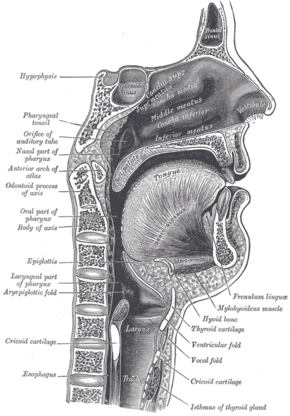 |frameless|alt=]]

| Details | |
|---|---|
| Synonyms | |
| Pronunciation | |
| Carnegie stage | |
| Days | |
| Precursor | |
| Gives rise to | |
| Part of | Paranasal sinuses |
The maxillary sinus (or antrum of Highmore) is one of the four paranasal sinuses, which are air-filled spaces located within the bones of the skull and face. The maxillary sinuses are the largest of the paranasal sinuses and are located within the maxilla (upper jaw) on either side of the nasal cavity.
Anatomy[edit]
The maxillary sinus is pyramidal in shape and has three walls: the anterior wall (facial surface), the posterior wall (infratemporal surface), and the medial wall (nasal surface). The roof of the sinus is formed by the floor of the orbit, and the floor of the sinus is formed by the alveolar process of the maxilla, which contains the roots of the upper teeth.
Function[edit]
The primary function of the maxillary sinus, like other paranasal sinuses, is to produce mucus that moisturizes the inside of the nose. This mucus layer protects the nose from pollutants, micro-organisms, dust, and dirt. The sinuses also help to lighten the weight of the skull and improve the resonance of the voice.
Clinical significance[edit]
Sinusitis[edit]
Maxillary sinusitis is an inflammation of the maxillary sinus, often caused by infection. Symptoms may include facial pain, nasal congestion, and discharge. Chronic maxillary sinusitis can result from unresolved acute sinusitis or other factors such as allergies or structural abnormalities.
Dental implications[edit]
Due to the close proximity of the maxillary sinus to the roots of the upper teeth, dental infections or procedures can sometimes lead to sinusitis. Conversely, sinus infections can sometimes cause referred pain to the upper teeth.
Surgical considerations[edit]
Surgical procedures involving the maxillary sinus include functional endoscopic sinus surgery (FESS) and Caldwell-Luc operation. These procedures are typically performed to treat chronic sinusitis or to remove sinus tumors.
Development[edit]
The maxillary sinuses are present at birth but are very small. They continue to grow and develop throughout childhood and reach their full size after the permanent teeth have erupted.
See also[edit]
References[edit]
 | This medical article is a stub. You can help WikiMD by expanding the page. |

Medical Disclaimer: WikiMD is for informational purposes only and is not a substitute for professional medical advice. Content may be inaccurate or outdated and should not be used for diagnosis or treatment. Always consult your healthcare provider for medical decisions. Verify information with trusted sources such as CDC.gov and NIH.gov. By using this site, you agree that WikiMD is not liable for any outcomes related to its content. See full disclaimer.
Credits:Most images are courtesy of Wikimedia commons, and templates, categories Wikipedia, licensed under CC BY SA or similar.
Translate page: - East Asian
中文,
日本,
한국어,
South Asian
हिन्दी,
தமிழ்,
తెలుగు,
Urdu,
ಕನ್ನಡ,
Southeast Asian
Indonesian,
Vietnamese,
Thai,
မြန်မာဘာသာ,
বাংলা
European
español,
Deutsch,
français,
Greek,
português do Brasil,
polski,
română,
русский,
Nederlands,
norsk,
svenska,
suomi,
Italian
Middle Eastern & African
عربى,
Turkish,
Persian,
Hebrew,
Afrikaans,
isiZulu,
Kiswahili,
Other
Bulgarian,
Hungarian,
Czech,
Swedish,
മലയാളം,
मराठी,
ਪੰਜਾਬੀ,
ગુજરાતી,
Portuguese,
Ukrainian

