Lying (position)
The lying (position) or recumbency is a type of human position in which the body is more or less horizontal and supported along its length by the surface underneath. When lying, the body may assume a great variety of shapes and positions. The following are the basic recognized positions.
Types of lying positions[edit]
Supine position[edit]
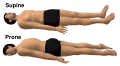
The supine position means lying horizontally with the face and torso facing up, as opposed to the prone position, which is face down. When used in surgical procedures, it allows access to the peritoneal, thoracic and pericardial regions; as well as the head, neck and extremities.
Prone position[edit]
The prone position is a body position in which one lies flat with the chest down and the back up. In anatomical terms of location, the dorsal side is up, and the ventral side is down.
Lateral decubitus[edit]
The lateral decubitus position is when a person lies on their side. It can refer to either the left or right side. The left lateral decubitus position refers to when a person lies on their left side.
Health effects[edit]
Lying, particularly prolonged bed rest, has many health effects, including muscle atrophy, bedsores, thrombosis, and a decrease in bone density.
See also[edit]
References[edit]

This WikiMD article can only be edited by registered and verified editors. You can log in or register.
-
 Lying (position)
 -
 Lying (position)
 -
 Lying (position)
 -
 Lying (position)


Medical Disclaimer: WikiMD is for informational purposes only and is not a substitute for professional medical advice. Content may be inaccurate or outdated and should not be used for diagnosis or treatment. Always consult your healthcare provider for medical decisions. Verify information with trusted sources such as CDC.gov and NIH.gov. By using this site, you agree that WikiMD is not liable for any outcomes related to its content. See full disclaimer.
Credits:Most images are courtesy of Wikimedia commons, and templates, categories Wikipedia, licensed under CC BY SA or similar.
Translate page: - East Asian
中文,
日本,
한국어,
South Asian
हिन्दी,
தமிழ்,
తెలుగు,
Urdu,
ಕನ್ನಡ,
Southeast Asian
Indonesian,
Vietnamese,
Thai,
မြန်မာဘာသာ,
বাংলা
European
español,
Deutsch,
français,
Greek,
português do Brasil,
polski,
română,
русский,
Nederlands,
norsk,
svenska,
suomi,
Italian
Middle Eastern & African
عربى,
Turkish,
Persian,
Hebrew,
Afrikaans,
isiZulu,
Kiswahili,
Other
Bulgarian,
Hungarian,
Czech,
Swedish,
മലയാളം,
मराठी,
ਪੰਜਾਬੀ,
ગુજરાતી,
Portuguese,
Ukrainian

