Lumbar puncture
A lumbar puncture (LP), also known as a spinal tap, is a medical procedure where a needle is inserted into the lower part of the spinal column to extract cerebrospinal fluid (CSF) for diagnostic or therapeutic purposes. The procedure involves accessing the subarachnoid space in the lumbar region of the spinal cord, below the level where the spinal cord ends, to avoid injury to the spinal cord itself.
Procedure[edit]
The lumbar puncture is typically performed with the patient lying on their side with their knees drawn up towards their chest, or seated and leaning forward. After cleaning the lumbar area with an antiseptic solution, local anesthesia is applied to numb the area. A thin needle is then carefully inserted between the vertebrae, through the dura and arachnoid membranes, and into the subarachnoid space[1].
Indications[edit]
Lumbar puncture is often performed to collect CSF for diagnostic testing. It is commonly used in the diagnosis of conditions such as meningitis, subarachnoid hemorrhage, and certain neurological disorders, where abnormalities in the composition of the CSF may provide important clues. It may also be used therapeutically, such as in the administration of medications like chemotherapy drugs, or to relieve pressure in the CSF space due to conditions like idiopathic intracranial hypertension[2].
Risks and Complications[edit]
While generally considered safe, lumbar puncture is not without risk. Potential complications include post-dural puncture headache, infection, bleeding, and damage to the spinal cord or nerves. Serious complications are rare but can include brain herniation in patients with increased intracranial pressure[3].
Summary[edit]
A lumbar puncture is a crucial tool in modern medicine, allowing for the diagnosis and treatment of a range of neurological conditions. While the procedure carries some risks, it is generally safe when performed by trained professionals on appropriately selected patients[4].
References[edit]
See Also[edit]

This WikiMD article can only be edited by registered and verified editors. You can log in or register.
-
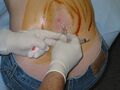 Lumbar puncture procedure
 -
Diagram of a spinal tap
-
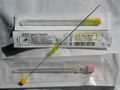 Needles used for lumbar puncture
 -
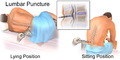 Illustration of lumbar puncture
 -
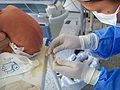 Lumbar puncture on a newborn
 -
 Lumbar puncture for meningitis diagnosis


Medical Disclaimer: WikiMD is for informational purposes only and is not a substitute for professional medical advice. Content may be inaccurate or outdated and should not be used for diagnosis or treatment. Always consult your healthcare provider for medical decisions. Verify information with trusted sources such as CDC.gov and NIH.gov. By using this site, you agree that WikiMD is not liable for any outcomes related to its content. See full disclaimer.
Credits:Most images are courtesy of Wikimedia commons, and templates, categories Wikipedia, licensed under CC BY SA or similar.
Translate page: - East Asian
中文,
日本,
한국어,
South Asian
हिन्दी,
தமிழ்,
తెలుగు,
Urdu,
ಕನ್ನಡ,
Southeast Asian
Indonesian,
Vietnamese,
Thai,
မြန်မာဘာသာ,
বাংলা
European
español,
Deutsch,
français,
Greek,
português do Brasil,
polski,
română,
русский,
Nederlands,
norsk,
svenska,
suomi,
Italian
Middle Eastern & African
عربى,
Turkish,
Persian,
Hebrew,
Afrikaans,
isiZulu,
Kiswahili,
Other
Bulgarian,
Hungarian,
Czech,
Swedish,
മലയാളം,
मराठी,
ਪੰਜਾਬੀ,
ગુજરાતી,
Portuguese,
Ukrainian


