Tubulinea
Tubulinea is a class of amoebozoa characterized by their tubular pseudopodia. These organisms are primarily found in freshwater and soil environments, where they play a significant role in the ecosystem as decomposers and predators of bacteria and other small organisms.
Characteristics[edit]
Tubulinea are distinguished by their tubular, cylindrical pseudopodia, which are used for movement and feeding. Unlike other amoeboid organisms, the pseudopodia of Tubulinea are not supported by microtubules but are instead formed by the flow of cytoplasm. This class includes some of the most well-known amoebas, such as Amoeba proteus and Chaos carolinense.

The cell structure of Tubulinea is relatively simple, lacking the complex organelles found in more advanced eukaryotes. They possess a single nucleus, although some species, like Chaos carolinense, can have multiple nuclei. The cytoplasm is divided into a clear outer ectoplasm and a granular inner endoplasm, which contains the cell's organelles.
Ecology[edit]
Tubulinea are found in a variety of habitats, including freshwater, marine, and terrestrial environments. They are particularly abundant in soil, where they contribute to nutrient cycling by breaking down organic matter. In aquatic environments, they are important components of the microbial food web, preying on bacteria, algae, and other small protists.

These amoebas are also known for their ability to form cysts, which allow them to survive unfavorable conditions such as desiccation or nutrient depletion. The cysts are resistant to environmental stresses and can remain dormant for extended periods until conditions improve.
Reproduction[edit]
Reproduction in Tubulinea is primarily asexual, occurring through binary fission. During this process, the amoeba divides into two genetically identical daughter cells. Some species are also capable of sexual reproduction, although this is less common and not as well understood.
Diversity[edit]
The class Tubulinea includes several orders, such as Amoebida, Arcellinida, and Leptomyxida. Each order contains species with unique adaptations to their specific environments.

- Amoebida includes the well-known Amoeba proteus, which is often studied in biology classes due to its large size and ease of observation.
- Arcellinida are testate amoebas, which means they have a shell or test that protects their cell body. Arcella is a common genus within this order.
- Leptomyxida are amoebas with a more flattened body shape, adapted to moving through narrow spaces in soil and sediment.
Significance[edit]
Tubulinea play a crucial role in ecosystems as decomposers and as part of the microbial food web. They help recycle nutrients by breaking down organic matter and controlling bacterial populations. Their presence in soil and water is an indicator of environmental health and biodiversity.

Related pages[edit]

Gallery[edit]
-
 Amoeba proteus with many pseudopodia
 -
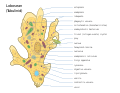 Diagram of lobosean amoebas
 -
 Amoeba proteus
 -
 Chaos carolinense
 -
 Arcella sp.
 -
 Trichosphaerium sieboldi

Medical Disclaimer: WikiMD is for informational purposes only and is not a substitute for professional medical advice. Content may be inaccurate or outdated and should not be used for diagnosis or treatment. Always consult your healthcare provider for medical decisions. Verify information with trusted sources such as CDC.gov and NIH.gov. By using this site, you agree that WikiMD is not liable for any outcomes related to its content. See full disclaimer.
Credits:Most images are courtesy of Wikimedia commons, and templates, categories Wikipedia, licensed under CC BY SA or similar.
Translate this page: - East Asian
中文,
日本,
한국어,
South Asian
हिन्दी,
தமிழ்,
తెలుగు,
Urdu,
ಕನ್ನಡ,
Southeast Asian
Indonesian,
Vietnamese,
Thai,
မြန်မာဘာသာ,
বাংলা
European
español,
Deutsch,
français,
Greek,
português do Brasil,
polski,
română,
русский,
Nederlands,
norsk,
svenska,
suomi,
Italian
Middle Eastern & African
عربى,
Turkish,
Persian,
Hebrew,
Afrikaans,
isiZulu,
Kiswahili,
Other
Bulgarian,
Hungarian,
Czech,
Swedish,
മലയാളം,
मराठी,
ਪੰਜਾਬੀ,
ગુજરાતી,
Portuguese,
Ukrainian
