Median arcuate ligament
The Median Arcuate Ligament (MAL) is an anatomical structure found in the human body. It is a fibrous arch that crosses in front of the aorta, just above the coeliac trunk. The ligament is formed by the right and left diaphragmatic crura, which are two tendinous structures that extend downward from the diaphragm.
Etymology[edit]
The term "Median Arcuate Ligament" is derived from the Latin words "medius" meaning middle, "arcuatus" meaning arched, and "ligamentum" meaning band. Thus, the term can be translated as "middle arched band".
Anatomy[edit]
The Median Arcuate Ligament is a part of the posterior abdominal wall. It is located at the level of the first lumbar vertebra, crossing in front of the aorta and behind the lesser omentum and the stomach. The ligament is formed by the medial edges of the diaphragmatic crura on either side of the aortic hiatus. The crura are tendinous structures that extend downward from the diaphragm and give it stability.
Clinical Significance[edit]
In some individuals, the Median Arcuate Ligament can compress the coeliac trunk, a condition known as Median Arcuate Ligament Syndrome (MALS). This can lead to symptoms such as abdominal pain, weight loss, and nausea. Diagnosis is typically made through imaging studies such as CT or MRI, and treatment often involves surgical release of the ligament.
Related Terms[edit]
See Also[edit]

This WikiMD article can only be edited by registered and verified editors. You can log in or register.
Median arcuate ligament gallery[edit]
-
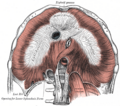 Gray's Anatomy illustration of the median arcuate ligament


Medical Disclaimer: WikiMD is for informational purposes only and is not a substitute for professional medical advice. Content may be inaccurate or outdated and should not be used for diagnosis or treatment. Always consult your healthcare provider for medical decisions. Verify information with trusted sources such as CDC.gov and NIH.gov. By using this site, you agree that WikiMD is not liable for any outcomes related to its content. See full disclaimer.
Credits:Most images are courtesy of Wikimedia commons, and templates, categories Wikipedia, licensed under CC BY SA or similar.
Translate page: - East Asian
中文,
日本,
한국어,
South Asian
हिन्दी,
தமிழ்,
తెలుగు,
Urdu,
ಕನ್ನಡ,
Southeast Asian
Indonesian,
Vietnamese,
Thai,
မြန်မာဘာသာ,
বাংলা
European
español,
Deutsch,
français,
Greek,
português do Brasil,
polski,
română,
русский,
Nederlands,
norsk,
svenska,
suomi,
Italian
Middle Eastern & African
عربى,
Turkish,
Persian,
Hebrew,
Afrikaans,
isiZulu,
Kiswahili,
Other
Bulgarian,
Hungarian,
Czech,
Swedish,
മലയാളം,
मराठी,
ਪੰਜਾਬੀ,
ગુજરાતી,
Portuguese,
Ukrainian

