Iridectomy
Iridectomy, also known as a corectomy, is a surgical procedure that involves the removal of a portion of the iris, the colored part of the eye. This procedure is typically performed to treat various eye conditions, such as glaucoma and melanoma of the iris.
Procedure[edit]
An iridectomy can be performed as a traditional surgical procedure or as a laser procedure. In a traditional surgical iridectomy, a small incision is made in the cornea or the sclera. A portion of the iris is then removed through this incision. In a laser iridectomy, a laser is used to create a hole in the iris, allowing fluid to flow more freely within the eye.
Indications[edit]
Iridectomy is most commonly performed to treat glaucoma, a condition that increases pressure within the eye and can lead to vision loss. By removing a portion of the iris, the flow of fluid within the eye can be improved, reducing pressure.
Iridectomy may also be performed to treat a melanoma of the iris. In this case, the portion of the iris containing the tumor is removed in an attempt to prevent the spread of cancer.
Risks and Complications[edit]
As with any surgical procedure, there are risks associated with an iridectomy. These may include infection, bleeding, and damage to other structures within the eye. There is also a risk that the procedure will not successfully reduce eye pressure or halt the progression of a melanoma.
See Also[edit]

This WikiMD article can only be edited by registered and verified editors. You can log in or register.
Iridectomy[edit]
-
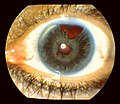 Large iridectomy deforms pupil
 -
 Ancient Hindu iridectomy knives, one used by modern surgeons


Medical Disclaimer: WikiMD is for informational purposes only and is not a substitute for professional medical advice. Content may be inaccurate or outdated and should not be used for diagnosis or treatment. Always consult your healthcare provider for medical decisions. Verify information with trusted sources such as CDC.gov and NIH.gov. By using this site, you agree that WikiMD is not liable for any outcomes related to its content. See full disclaimer.
Credits:Most images are courtesy of Wikimedia commons, and templates, categories Wikipedia, licensed under CC BY SA or similar.
Translate page: - East Asian
中文,
日本,
한국어,
South Asian
हिन्दी,
தமிழ்,
తెలుగు,
Urdu,
ಕನ್ನಡ,
Southeast Asian
Indonesian,
Vietnamese,
Thai,
မြန်မာဘာသာ,
বাংলা
European
español,
Deutsch,
français,
Greek,
português do Brasil,
polski,
română,
русский,
Nederlands,
norsk,
svenska,
suomi,
Italian
Middle Eastern & African
عربى,
Turkish,
Persian,
Hebrew,
Afrikaans,
isiZulu,
Kiswahili,
Other
Bulgarian,
Hungarian,
Czech,
Swedish,
മലയാളം,
मराठी,
ਪੰਜਾਬੀ,
ગુજરાતી,
Portuguese,
Ukrainian

