Bethesda system
Bethesda System is a system used for reporting cervical or vaginal cytologic diagnoses. It was first introduced in 1988 and later revised in 1991, 2001, and 2014. The system is named after Bethesda, Maryland, where the conference that established the system was held.
History[edit]
The Bethesda System was developed during a National Cancer Institute (NCI) workshop in Bethesda, Maryland in 1988. The goal was to provide a universal approach to cytology reporting, which would allow for better communication between laboratories, clinicians, and patients. The system was revised in 1991, 2001, and 2014 to incorporate new scientific understanding and improve clinical utility.
Structure[edit]
The Bethesda System has three main components: the specimen type, the general categorization, and the interpretation/result. The specimen type indicates the source of the cytologic material. The general categorization is an optional component that classifies the specimen as "satisfactory for evaluation" or "unsatisfactory for evaluation". The interpretation/result provides the diagnosis.
Usage[edit]
The Bethesda System is used worldwide for the reporting of cervical-vaginal cytology. It has been adopted by many countries due to its simplicity, clarity, and flexibility. The system allows for the easy exchange of information and comparison of data, which is crucial for patient care and research.
Criticism[edit]
Despite its widespread use, the Bethesda System has been criticized for its perceived complexity and subjectivity. Some clinicians and researchers argue that the system's categories are too broad and that its terminology is confusing. However, proponents of the system argue that these issues are outweighed by the benefits of standardization and improved communication.
See also[edit]
 | This medical article is a stub. You can help WikiMD by expanding the page. |
 | This oncology article is a stub. You can help WikiMD by expanding the page. |
-
Cytopathology of low-grade squamous intraepithelial lesion (LSIL)
-
 High-grade squamous intraepithelial lesion
 -
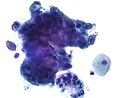 Adenocarcinoma on pap test
 -
Thyroid cytopathology of Bethesda category III with clotting artifact
-
Thyroid cytopathology of Bethesda category IV
-
Thyroid cytopathology of Bethesda category V with intranuclear cytoplasmic inclusion
-
Thyroid cytopathology of Bethesda category V with nuclear groove
-
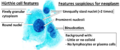 Cytopathology suspicious for Hürthle cell neoplasm


Advertise on WikiMD — 81,000+ full articles, ~900,000 total pages, ~250 million page views. Global reach, limited time promotional rates from $1/page/day. Learn more · View stats

Medical Disclaimer: WikiMD is for informational purposes only and is not a substitute for professional medical advice. Content may be inaccurate or outdated and should not be used for diagnosis or treatment. Always consult your healthcare provider for medical decisions. Verify information with trusted sources such as CDC.gov and NIH.gov. By using this site, you agree that WikiMD is not liable for any outcomes related to its content. See full disclaimer.
Credits:Most images are courtesy of Wikimedia commons, and templates, categories Wikipedia, licensed under CC BY SA or similar.
Translate page: - East Asian
中文,
日本,
한국어,
South Asian
हिन्दी,
தமிழ்,
తెలుగు,
Urdu,
ಕನ್ನಡ,
Southeast Asian
Indonesian,
Vietnamese,
Thai,
မြန်မာဘာသာ,
বাংলা
European
español,
Deutsch,
français,
Greek,
português do Brasil,
polski,
română,
русский,
Nederlands,
norsk,
svenska,
suomi,
Italian
Middle Eastern & African
عربى,
Turkish,
Persian,
Hebrew,
Afrikaans,
isiZulu,
Kiswahili,
Other
Bulgarian,
Hungarian,
Czech,
Swedish,
മലയാളം,
मराठी,
ਪੰਜਾਬੀ,
ગુજરાતી,
Portuguese,
Ukrainian


.png)


