Hypoglossal nerve
Hypoglossal nerve is the twelfth cranial nerve in the human body. It is responsible for the movement of most of the muscles in the tongue, and is thus an important factor in speech, swallowing, and other functions.
Anatomy[edit]
The hypoglossal nerve originates in the medulla oblongata, a part of the brainstem. It travels through the hypoglossal canal, a small passage in the occipital bone of the skull, before it reaches the tongue.
Function[edit]
The hypoglossal nerve controls the movement of the tongue. It is responsible for the contraction of the muscles that allow the tongue to move in various directions, such as protrusion, retraction, and side-to-side movement. This is crucial for several functions, including speech, swallowing, and cleaning the oral cavity.
Clinical significance[edit]
Damage to the hypoglossal nerve can result in hypoglossal nerve palsy, a condition characterized by a loss of control over the tongue muscles. This can lead to difficulties with speech and swallowing, and in severe cases, can cause the tongue to atrophy and deviate towards the side of the injury.
See also[edit]
References[edit]

This WikiMD article can only be edited by registered and verified editors. You can log in or register.
-
 Anterior view of the human brainstem
 -
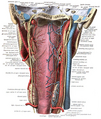 Illustration from Sobo 1909
 -
 Hypoglossal nerve
 -
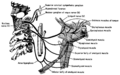 Diagram from Lawrence 1960
 -
 Unilateral hypoglossal nerve injury


Medical Disclaimer: WikiMD is for informational purposes only and is not a substitute for professional medical advice. Content may be inaccurate or outdated and should not be used for diagnosis or treatment. Always consult your healthcare provider for medical decisions. Verify information with trusted sources such as CDC.gov and NIH.gov. By using this site, you agree that WikiMD is not liable for any outcomes related to its content. See full disclaimer.
Credits:Most images are courtesy of Wikimedia commons, and templates, categories Wikipedia, licensed under CC BY SA or similar.
Translate page: - East Asian
中文,
日本,
한국어,
South Asian
हिन्दी,
தமிழ்,
తెలుగు,
Urdu,
ಕನ್ನಡ,
Southeast Asian
Indonesian,
Vietnamese,
Thai,
မြန်မာဘာသာ,
বাংলা
European
español,
Deutsch,
français,
Greek,
português do Brasil,
polski,
română,
русский,
Nederlands,
norsk,
svenska,
suomi,
Italian
Middle Eastern & African
عربى,
Turkish,
Persian,
Hebrew,
Afrikaans,
isiZulu,
Kiswahili,
Other
Bulgarian,
Hungarian,
Czech,
Swedish,
മലയാളം,
मराठी,
ਪੰਜਾਬੀ,
ગુજરાતી,
Portuguese,
Ukrainian

