Hydraulics
Hydraulics is a technology and applied science using engineering, chemistry, and other sciences involving the mechanical properties and use of liquids. At a very basic level, hydraulics is the liquid counterpart of pneumatics, which concerns gases.
Principles of hydraulics[edit]
Hydraulics derives from the Greek word ὑδραυλικός (hydraulikos) which in turn comes from ὕδωρ (hydor, Greek for water) and αὐλός (aulos, meaning pipe).
A fundamental feature of hydraulics is the ability to use leverage and Pascal's law to generate a large force over a large distance or leverage. The hydraulic lever, a simple machine, was used extensively in the construction of ancient structures like the Pyramids.
Applications of hydraulics[edit]
Hydraulics is used in many areas such as in the mechanical industry, the automotive industry, construction equipment, mining, materials handling, oil and gas, etc. Some examples include backhoes, dump trucks, hydraulic presses, and hydraulic cylinders.
Hydraulic circuits[edit]
A hydraulic circuit is a system comprising an interconnected set of discrete components that transport liquid. The purpose of this system may be to control where fluid flows (as in a network of tubes of coolant in a thermodynamic system) or to control fluid pressure (as in hydraulic amplifiers).
See also[edit]
- Fluid dynamics
- Hydraulic drive system
- Hydraulic engineering
- Hydraulic fluid
- Hydraulic machinery
- Hydraulic motor
- Hydraulic pump
- Hydraulic transmission
References[edit]
External links[edit]
- WikiMD

This WikiMD article can only be edited by registered and verified editors. You can log in or register.
-
 Hydraulics
 -
 Open Channel
 -
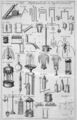 Table of Hydraulics and Hydrostatics
 -
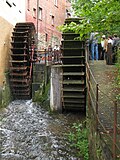 Tübingen Gerstenmühle
 -
 Sigiriya Moat and Garden
 -
 Segovia Aqueduct
.svg)


Medical Disclaimer: WikiMD is for informational purposes only and is not a substitute for professional medical advice. Content may be inaccurate or outdated and should not be used for diagnosis or treatment. Always consult your healthcare provider for medical decisions. Verify information with trusted sources such as CDC.gov and NIH.gov. By using this site, you agree that WikiMD is not liable for any outcomes related to its content. See full disclaimer.
Credits:Most images are courtesy of Wikimedia commons, and templates, categories Wikipedia, licensed under CC BY SA or similar.
Translate page: - East Asian
中文,
日本,
한국어,
South Asian
हिन्दी,
தமிழ்,
తెలుగు,
Urdu,
ಕನ್ನಡ,
Southeast Asian
Indonesian,
Vietnamese,
Thai,
မြန်မာဘာသာ,
বাংলা
European
español,
Deutsch,
français,
Greek,
português do Brasil,
polski,
română,
русский,
Nederlands,
norsk,
svenska,
suomi,
Italian
Middle Eastern & African
عربى,
Turkish,
Persian,
Hebrew,
Afrikaans,
isiZulu,
Kiswahili,
Other
Bulgarian,
Hungarian,
Czech,
Swedish,
മലയാളം,
मराठी,
ਪੰਜਾਬੀ,
ગુજરાતી,
Portuguese,
Ukrainian

