Healthcare reform in the United States
Healthcare reform in the United States refers to the ongoing efforts to improve the healthcare system in the country. The United States has a complex healthcare system that is a mix of private and public insurance programs, making it one of the most expensive healthcare systems in the world. This article provides an overview of the key aspects of healthcare reform in the United States.
Background[edit]
The need for healthcare reform in the United States has been a topic of debate for many years. The high cost of healthcare, lack of access to affordable insurance, and disparities in healthcare outcomes have been major concerns. In response to these issues, various healthcare reform initiatives have been proposed and implemented over the years.
Affordable Care Act (ACA)[edit]
One of the most significant healthcare reform efforts in the United States is the Affordable Care Act (ACA), also known as Obamacare. The ACA was signed into law in 2010 with the aim of expanding access to affordable healthcare coverage. It introduced several key provisions, including the establishment of health insurance marketplaces, expansion of Medicaid eligibility, and the requirement for individuals to have health insurance or pay a penalty.
The ACA also introduced various consumer protections, such as prohibiting insurance companies from denying coverage based on pre-existing conditions and allowing young adults to stay on their parents' insurance plans until the age of 26. These provisions aimed to address some of the longstanding issues in the healthcare system.
Impact of the ACA[edit]
The ACA had a significant impact on the healthcare landscape in the United States. It resulted in millions of previously uninsured individuals gaining access to health insurance coverage. The expansion of Medicaid eligibility played a crucial role in increasing coverage for low-income individuals. However, the ACA also faced criticism, with some arguing that it led to higher premiums for certain individuals and limited choices in the insurance market.
Current Challenges[edit]
Despite the implementation of the ACA, challenges in the healthcare system persist. The rising cost of healthcare remains a major concern, with healthcare spending in the United States far exceeding that of other developed countries. Additionally, access to healthcare services continues to be an issue, particularly for underserved populations.
Another ongoing challenge is the political divide surrounding healthcare reform. Different political parties have differing views on the best approach to reforming the healthcare system, leading to ongoing debates and difficulties in implementing comprehensive reforms.
Future Directions[edit]
Efforts to address the challenges in the healthcare system are ongoing. Some proposed solutions include expanding access to affordable insurance, implementing cost containment measures, and promoting preventive care. Additionally, there is a growing focus on addressing social determinants of health, such as income inequality and education, which can have a significant impact on health outcomes.
Conclusion[edit]
Healthcare reform in the United States is a complex and ongoing process. While the ACA made significant strides in expanding access to healthcare coverage, challenges remain. Continued efforts to address the rising cost of healthcare, improve access to services, and promote equitable health outcomes are crucial for achieving meaningful healthcare reform in the United States.
See Also[edit]
References[edit]
Healthcare reform in the United States[edit]
-
 Medicaid expansion map of US
 -
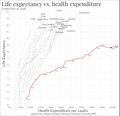 Life expectancy vs healthcare spending
 -
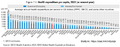 Average annual health spending
 -
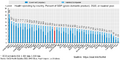 Health spending by country
 -
 Total health expenditure per capita
 -
 Ms. magazine Cover - Spring 2010
 -
 U.S. Uninsured and Uninsured Rate (1987 to 2008)


_per_person._OECD_countries_and_more.png)
.png)


.JPG)

Medical Disclaimer: WikiMD is for informational purposes only and is not a substitute for professional medical advice. Content may be inaccurate or outdated and should not be used for diagnosis or treatment. Always consult your healthcare provider for medical decisions. Verify information with trusted sources such as CDC.gov and NIH.gov. By using this site, you agree that WikiMD is not liable for any outcomes related to its content. See full disclaimer.
Credits:Most images are courtesy of Wikimedia commons, and templates, categories Wikipedia, licensed under CC BY SA or similar.
Translate page: - East Asian
中文,
日本,
한국어,
South Asian
हिन्दी,
தமிழ்,
తెలుగు,
Urdu,
ಕನ್ನಡ,
Southeast Asian
Indonesian,
Vietnamese,
Thai,
မြန်မာဘာသာ,
বাংলা
European
español,
Deutsch,
français,
Greek,
português do Brasil,
polski,
română,
русский,
Nederlands,
norsk,
svenska,
suomi,
Italian
Middle Eastern & African
عربى,
Turkish,
Persian,
Hebrew,
Afrikaans,
isiZulu,
Kiswahili,
Other
Bulgarian,
Hungarian,
Czech,
Swedish,
മലയാളം,
मराठी,
ਪੰਜਾਬੀ,
ગુજરાતી,
Portuguese,
Ukrainian

