Orthohantavirus
Orthohantavirus is a genus of viruses in the family Hantaviridae. Orthohantaviruses are enveloped viruses with a genomic structure of three single-stranded, negative sense RNA segments. The viruses are primarily rodent-borne and are responsible for several types of hantavirus infections in humans, which can lead to severe and often fatal respiratory or hemorrhagic diseases.
Classification[edit]
Orthohantaviruses are classified into four sections based on their antigenic properties and the rodent host species: the Hantaan-like viruses, the Seoul-like viruses, the Puumala-like viruses, and the Sin Nombre-like viruses. Each section contains multiple virus species.
Transmission[edit]
Orthohantaviruses are primarily transmitted to humans through inhalation of aerosolized virus particles from the feces, urine, or saliva of infected rodents. Direct contact with infected rodents or their droppings, and rarely, rodent bites, can also result in transmission.
Diseases[edit]
Orthohantaviruses can cause two types of diseases in humans: Hantavirus Pulmonary Syndrome (HPS) and Hemorrhagic Fever with Renal Syndrome (HFRS). Both diseases have high mortality rates and are characterized by sudden onset of fever, fatigue, and other flu-like symptoms, followed by respiratory or renal failure.
Prevention and Control[edit]
Prevention of orthohantavirus infections primarily involves avoiding contact with rodents and taking precautions to prevent rodent infestations. There is currently no specific antiviral treatment for orthohantavirus infections, and treatment is primarily supportive.
See Also[edit]
- Hantavirus
- Hantavirus Pulmonary Syndrome
- Hemorrhagic Fever with Renal Syndrome
- Rodent-borne diseases

This WikiMD article can only be edited by registered and verified editors. You can log in or register.
-
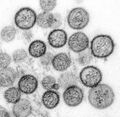 Sin Nombre virus under a transmission electron microscope
 -
 Rötelmaus (bank vole)
 -
 Deer mouse
 -
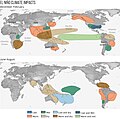 NOAA Niño
 -
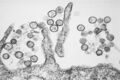 Sin Nombre virus under a transmission electron microscope


Medical Disclaimer: WikiMD is for informational purposes only and is not a substitute for professional medical advice. Content may be inaccurate or outdated and should not be used for diagnosis or treatment. Always consult your healthcare provider for medical decisions. Verify information with trusted sources such as CDC.gov and NIH.gov. By using this site, you agree that WikiMD is not liable for any outcomes related to its content. See full disclaimer.
Credits:Most images are courtesy of Wikimedia commons, and templates, categories Wikipedia, licensed under CC BY SA or similar.
Translate page: - East Asian
中文,
日本,
한국어,
South Asian
हिन्दी,
தமிழ்,
తెలుగు,
Urdu,
ಕನ್ನಡ,
Southeast Asian
Indonesian,
Vietnamese,
Thai,
မြန်မာဘာသာ,
বাংলা
European
español,
Deutsch,
français,
Greek,
português do Brasil,
polski,
română,
русский,
Nederlands,
norsk,
svenska,
suomi,
Italian
Middle Eastern & African
عربى,
Turkish,
Persian,
Hebrew,
Afrikaans,
isiZulu,
Kiswahili,
Other
Bulgarian,
Hungarian,
Czech,
Swedish,
മലയാളം,
मराठी,
ਪੰਜਾਬੀ,
ગુજરાતી,
Portuguese,
Ukrainian

